
This post may contain affiliate links. If you decide to make a purchase through these links, I earn a small commission at no cost to you. I do not promote anything I do not believe in or stand behind.
Learning how to abide in Jesus can change the way you understand spiritual growth.
Picture a branch lying on the ground after a storm.
At first, it still looks alive. The leaves are green. From a distance, nothing seems wrong.
Picture a branch lying on the ground after a storm.
At first, it still looks alive.
The leaves are green.
From a distance, nothing seems wrong.
A few days later, however, the leaves begin to curl.
Soon they turn brown.
Eventually, the branch becomes dry and brittle.
What happened?
It became disconnected from the vine.
Many Christians understand that picture because they sometimes feel spiritually similar.
You still attend church.
You know Christian language.
Perhaps you read Scripture and serve others.
Yet inside, something feels dry.
Prayer becomes mechanical.
Temptation grows stronger.
Joy weakens.
You wonder:
“Why am I not growing?”
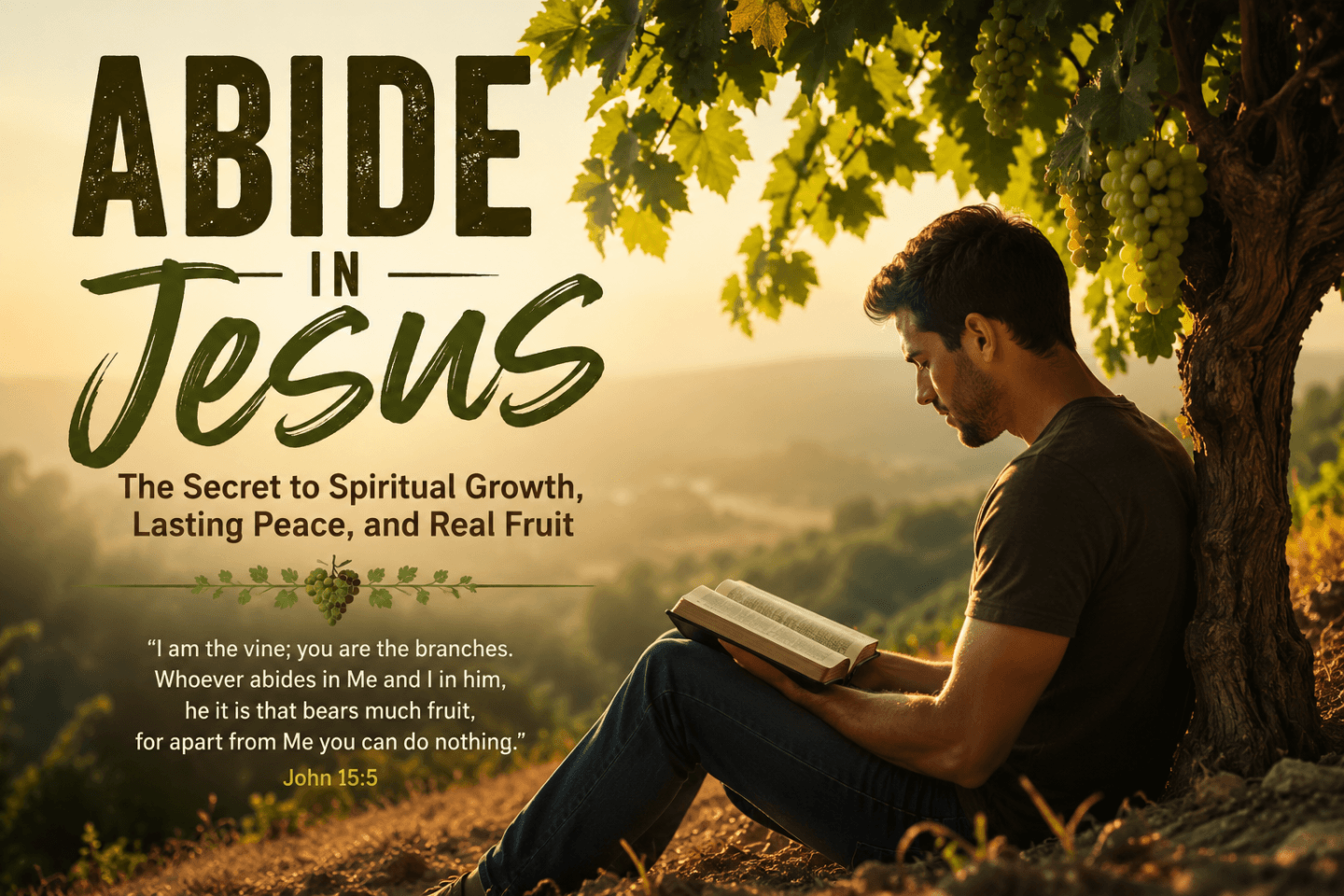
Jesus gives us one of the clearest answers in John 15:5:
“I am the vine; you are the branches. Whoever abides in me and I in him, he it is that bears much fruit, for apart from me you can do nothing.”
Christian growth does require effort.
Yet Christian effort was never meant to function independently from Christ.
The call of Jesus is:
Abide in Me.
What Does It Mean to Abide in Jesus?
To abide in Jesus means to remain in living, dependent relationship with Him.
The Greek verb translated abide carries the basic idea of remaining, staying, or continuing.
However, John 15 itself tells us what that remaining looks like.
Jesus speaks about:
His words abiding in us,
remaining in His love,
keeping His commandments,
praying,
bearing fruit,
and glorifying the Father.
Therefore, abiding is not a vague mystical feeling.
Neither is it merely thinking about Jesus continually.
To abide in Christ involves faith, dependence, His Word, love, obedience, prayer, and perseverance.
The branch receives life from the vine.
Likewise, believers bear spiritual fruit because their life is rooted in Christ.
Still, the metaphor does not mean Christians become passive.
Jesus commands His disciples to remain, obey, love, ask, and bear fruit.
Grace produces active discipleship.
Why You Cannot Produce Spiritual Fruit Apart From Christ
Jesus says:
“Apart from me you can do nothing.”
He is not saying unbelievers are incapable of performing any ordinary action.
People can work, build businesses, care for families, create art, and perform acts of civic good.
In context, Jesus is speaking about spiritual fruit produced by disciples who remain in Him.
We cannot manufacture Christlike character independently from Christ.
You may imitate outward behavior for a while.
However, lasting spiritual fruit comes through God’s work in us.
Galatians 5 calls it:
“the fruit of the Spirit.”
Therefore, the Christian question should not merely be:
“How can I force myself to become better?”
A deeper question is:
“Am I living dependently upon Christ as I pursue obedience?”
Christian maturity involves effort.
Yet it is grace-powered effort.
Abide in Jesus Before You Try Harder
Sometimes Christians respond to spiritual dryness with increased activity.
Read more.
Serve more.
Attend more meetings.
Work harder.
Those things may be valuable.
Still, activity cannot replace communion with Christ.
Imagine a branch saying:
“I will produce grapes if I just work harder.”
The problem is not insufficient determination.
The branch needs the vine.
Likewise, spiritual disciplines are not techniques that create life independently.
Prayer, Scripture, worship, fellowship, and obedience are means through which we live in dependence upon the Christ who already gives life.
Therefore, do not turn abiding into another performance test.
You are not trying to earn Christ’s acceptance.
You are learning to live from the grace you have received.
The Gospel Comes Before Abiding
This distinction matters enormously.
You do not abide in Jesus so that God will finally accept you.
The gospel comes first.
Jesus lived the righteous life we could not live.
He died for sinners.
He rose from the dead.
Those who trust Him are reconciled to God by grace.
Therefore, believers fight sin from acceptance, not for acceptance.
When you fail, repentance does not mean earning your way back into God’s favor.
You return to the Christ whose grace is your only hope.
First John 1:9 says:
“If we confess our sins, he is faithful and just to forgive us our sins and to cleanse us from all unrighteousness.”
Consequently, abiding is not anxious Christianity.
It is dependent Christianity.
1. Abide in Jesus Through His Word
Jesus says in John 15:7:
“If you abide in me, and my words abide in you…”
His words belong at the center of abiding.
Therefore:
read Scripture,
meditate upon it,
memorize important passages,
study it carefully,
and obey what you understand.
Do not merely ask:
“What verse will make me feel better today?”
Also ask:
“What does this reveal about Christ?”
“What does God command?”
“What needs correction in my thinking?”
“How should this truth shape my life?”
The Word keeps our understanding of Jesus anchored in revelation rather than imagination.
For more:
2. Learn to Abide in Jesus Through Prayer
Prayer expresses dependence.
Instead of carrying everything alone, we continually bring life before God.
Your marriage.
Children.
Work.
Temptations.
Decisions.
Fears.
Failures.
Ministry.
Short prayers throughout the day can help:
“Jesus, give me wisdom.”
“Lord, help me respond with grace.”
“Father, thank You for this gift.”
“Holy Spirit, help me obey what Scripture says.”
Those prayers do not replace dedicated prayer time.
Rather, they extend fellowship with God into ordinary life.
As prayer becomes part of everyday discipleship, we learn again that we are branches—not the vine.
For more:
3. Let the Words of Jesus Shape Your Mind
Our minds constantly receive information.
News.
Social media.
Entertainment.
Fear.
Advertising.
Other people’s opinions.
Therefore, abiding requires intentional attention.
Colossians 3:16 says:
“Let the word of Christ dwell in you richly…”
Notice the word dwell.
God’s Word should not merely visit your mind occasionally.
It should increasingly live there.
That means biblical truth becomes available when temptation arrives.
When fear rises, Scripture speaks.
If shame returns, the gospel answers.
When pride appears, God’s Word corrects.
This does not mean mechanically repeating verses until negative feelings disappear.
Rather, Scripture increasingly becomes the framework through which we interpret life.
How to Abide in Jesus When You Still Struggle With Sin
Perhaps you think:
“If I were truly abiding in Jesus, I would no longer struggle.”
That conclusion can produce unnecessary despair.
Believers still face temptation.
Galatians 5 describes conflict between the flesh and the Spirit.
Therefore, struggle itself is not proof that Christ has abandoned you.
The more important question is:
What do you do with the struggle?
Do you protect sin?
Excuse it?
Hide it?
Or do you bring it into the light and continue turning toward Christ?
A Christian struggling against pornography, for example, may need prayer, repentance, practical boundaries, accountability, and changed habits.
Abiding does not replace those actions.
Instead, dependence on Christ gives those actions their proper spiritual foundation.
For more:
4. Abide in Jesus Through Obedience
John 15:10 says:
“If you keep my commandments, you will abide in my love…”
We should not interpret this as:
“Obey perfectly or Jesus will stop loving you.”
Christ’s love is not wages paid for flawless performance.
Instead, Jesus connects remaining in His love with a life of discipleship and obedience.
Love for Christ cannot be permanently separated from His commands.
Therefore, abiding is not merely:
“I feel close to Jesus.”
It also asks:
“Am I obeying Jesus?”
Perhaps He has already made the next step clear through Scripture.
Forgive.
Tell the truth.
Reject sexual sin.
Serve someone.
Repent.
Love your spouse.
Keep your promise.
Then obey.
Sometimes the most spiritual thing you can do is simply follow what Christ has already said.
5. Stay Connected to the Body of Christ
Abiding in Jesus is deeply personal.
It is not individualistic.

Christ joins believers to His people.
Therefore, isolation should concern us.
You need Christians who can:
encourage you,
correct you,
pray with you,
teach you,
serve beside you,
and sometimes confront you.
Hebrews 10:24–25 tells believers not to neglect meeting together but to encourage one another.
Church attendance itself does not save anyone.
Still, intentionally separating yourself from Christian community removes one of God’s ordinary means of spiritual formation.
Do more than occupy a chair.
Know people.
Serve.
Receive care.
Give care.
Allow other believers to know the real you.
Branches belong to the same vine.
How to Abide in Jesus During Hard Times
Abiding becomes especially important when life hurts.
Financial pressure.
Illness.
Disappointment.
Grief.
Unanswered prayer.
Family problems.
Those circumstances can create the impression that God has moved farther away.
Yet suffering does not prove Christ has abandoned you.
In John 15, Jesus even speaks about the Father pruning fruitful branches.
Pruning can hurt.
However, we should avoid labeling every painful event as a specific act of divine pruning when Scripture has not told us that.
Instead, suffering becomes an opportunity to remain faithful when circumstances no longer reinforce our faith emotionally.
Pray.
Stay in Scripture.
Remain with God’s people.
Ask for help.
Continue obeying.
For more:
6. Abide in Jesus by Putting Sin to Death
Romans 8:13 says:
“If by the Spirit you put to death the deeds of the body, you will live.”
Notice both parts.
You put sin to death.
Yet you do it:
“by the Spirit.”
That is Christian sanctification.
We neither sit passively waiting for God to remove every sinful desire nor attempt holiness through independent willpower.
Instead, the Spirit empowers active obedience.
Therefore, expose hidden sin.
Confess.
Remove access.
Seek accountability.
Repair what can be repaired.
Change routines when necessary.
Most importantly, keep returning to Christ.
Grace does not teach us to tolerate sin.
Titus 2 says grace trains us to renounce ungodliness.
7. Learn to Remain When You Do Not Feel Anything
Some days fellowship with God feels joyful.
Other days feel ordinary.
At times, prayer may feel emotionally powerful.
Sometimes you read the Bible and nothing seems dramatic.
Remain.
Abiding is not measured primarily by spiritual sensations.
Faithfulness matters when feelings are absent.
A healthy marriage is not real only when both spouses experience intense emotion.
Relationship continues through ordinary days.
Similarly, your walk with Christ includes:
ordinary prayers,
ordinary obedience,
ordinary Bible reading,
ordinary Sunday worship,
ordinary acts of love.
Over decades, those seemingly small acts of faithfulness matter enormously.
Do not chase spiritual excitement so aggressively that ordinary discipleship begins to look disappointing.
Often, Christ forms us quietly.
What Does the Fruit of Abiding in Jesus Look Like?
Jesus says the branch that abides will bear fruit.
What kind of fruit?
John 15 itself points toward several things:
obedience,
love,
answered prayer aligned with Christ’s words,
joy,
and witness.
The broader New Testament adds qualities such as:
love,
joy,
peace,
patience,
kindness,
goodness,
faithfulness,
gentleness,
and self-control.
Therefore, fruit is not primarily:
platform size,
money,
ministry popularity,
church attendance numbers,
or public recognition.
Ask instead:
Am I becoming more like Christ?
Do I love people better?
Am I quicker to repent?
Is truth becoming more important than reputation?
Do I increasingly resist sin?
Has my character changed?
Spiritual fruit usually grows more slowly than we wish.
Yet genuine fruit becomes visible over time.
A Serious Warning in John 15
Jesus also gives a warning.
John 15:6 says:
“If anyone does not abide in me he is thrown away like a branch and withers…”
Christ’s warning should not be softened until it means nothing.
Remaining in Christ matters.
However, Christians disagree about how precisely the fruitless branches relate to questions such as apostasy, false profession, and perseverance.
Therefore, I would avoid building the section around speculative identifications such as:
“This branch represents Judas”
or using Demas as though John 15 explicitly explains his spiritual condition.
The central warning is already clear:
Do not presume upon outward religious association while living disconnected from genuine faith in Christ.
Christianity is not merely external activity.
Christ Himself is essential.
Abide in Jesus Without Turning Abiding Into a Formula
There is another danger.
You can turn abiding into a checklist:
30 minutes Bible.
20 minutes prayer.
Church twice a week.
No pornography.
Done.
Those practices can help.
Yet Jesus is not teaching a productivity system.
He is describing life with Him.
Therefore, spiritual disciplines should serve relationship and obedience rather than become measurements of superiority.
One Christian may spend an hour in morning prayer.
Another parent with several young children may have five quiet minutes before the house wakes.
Godliness is not measured with a stopwatch.
The question is whether our lives are increasingly rooted in Christ.
Abiding in Jesus and Practicing God’s Presence
These two ideas are related, but they are not identical.
Practicing God’s presence emphasizes consciously remembering that God is with us.
Abiding in Jesus in John 15 is broader.
It includes:
remaining in Christ,
His Word remaining in us,
obedience,
love,
prayer,
fruit,
and perseverance.
Therefore, the practices complement each other.
For a practical guide to cultivating awareness of God’s presence:
For broader daily fellowship:
How to Abide in Jesus: 7 Habits to Remember
Keep the process simple.
1. Remain in His Word.
Allow Christ’s teaching to shape your thinking.
2. Pray throughout the day.
Live dependently rather than independently.
3. Renew your mind with truth.
Do not let every competing voice disciple you.
4. Obey what Christ has revealed.
Abiding includes obedience.
5. Stay connected to His church.
Christian discipleship is communal.
6. Put sin to death by the Spirit.
Do not protect what Christ calls you to surrender.
7. Remain during dry and difficult seasons.
Faithfulness does not require constant emotional intensity.
These habits do not earn life from the vine.
They describe ways believers continue living in dependence upon the One who gives life.
How to Abide in Jesus Today
Take a few minutes today and read John 15:1–17 slowly.
Do not rush.
Notice every time Jesus uses words such as:
abide, fruit, love, commandments, ask, joy.
Then ask:
“What does Jesus Himself say abiding looks like?”
Perhaps one area of your life has slowly become independent from Him.
Bring it back.
Maybe there is hidden sin.
Confess it.
Perhaps prayer has become mechanical.
Talk honestly with Him.
You may be in a difficult season where God feels distant.
Remain.
The Christian life does not flourish because we become spiritually self-sufficient.
It flourishes because we continually receive from Christ.
To abide in Jesus is to remain in dependent faith, allowing His Word, love, commands, and Spirit to shape our lives until His fruit increasingly becomes visible in us.
Continue Growing in Christ
For practicing God’s presence:
For daily fellowship with God:
For prayer:
For God’s Word:
For fighting sin:
For responding to hardship:

I am a blogger, writer, pastor, Director of Zion Romania Bible School, husband to Olguta, a father and, most importantly, a child of God. I also completed my studies at the King’s University where I earned a B.A. in Theology with a concentration in Messianic Jewish Studies. I love Israel and I love the ‘Jewishness’ of the Bible.

[…] in distress when God revealed Himself to Him in a new way. Biblical gratitude grows as we learn to abide in Jesus and trust His promises, even when our feelings tell us […]