
This post may contain affiliate links. If you decide to make a purchase through these links, I earn a small commission at no cost to you. I do not promote anything I do not believe in or stand behind.
For many of us who grew up reading the Bible in Romanian, Cornilescu is a familiar name. A phrase from his translation can bring back the sound of Scripture read aloud at church. It may even be the wording that comes to mind when we pray and don’t know quite what to say.
It’s easy to turn those familiar pages without thinking about the people who helped put them in our hands. I’d like us to meet one of them today. Dumitru Cornilescu’s story is worth knowing, and it invites us to open our own Bibles again with gratitude and fresh attention.
Who was Dumitru Cornilescu?
Dumitru Cornilescu lived from 1891 to 1975. He was trained in the Romanian Orthodox Church and became a hierodeacon, a monk ordained as a deacon. He later served in an evangelical setting, and his translation became especially influential among Romanian-speaking evangelical Christians. 1
Christians had been reading Scripture in Romanian long before Cornilescu. He inherited a rich tradition and set himself a particular task: to put the Bible into Romanian that more people could readily understand.
I’m grateful for that distinction. It gives earlier translators their due and helps us see what Cornilescu actually gave us: a fresh rendering that continued to serve readers through revisions and across generations.
A translator and a princess
In a 1974 interview transcribed by Emanuel Conțac, Cornilescu remembered paying for a small devotional calendar out of what he earned as a church singer. He said he had begun translating Matthew to understand it better for himself. His devotional publishing drew the attention of Princess Ralu Callimachi, who offered to support the translation and printing of the Bible. 2
Conțac points out that some of the dates are hard to reconcile. We can listen to what Cornilescu remembered without asking a late-life interview to settle every detail of the timeline.
I find this part of his story encouraging. One person had time and skill to give. Another had the means to support the work. The name on the cover is Cornilescu’s, but he didn’t have to carry the work alone.
There’s room for that kind of quiet service in our churches, too. Some teach. Some edit, print, or give. And sometimes the most helpful thing you can do is put a good book into someone’s hands and make time to read it with them.
Dumitru Cornilescu before the famous Bible
Before his translation became widely known, Cornilescu studied theology and worked as a tutor and church singer. Voicu Bojan describes his time at Bucharest’s Cuibul cu Barză church, his friendship with the priest Tudor Popescu, and a reading circle where people were encouraged to engage with Christian texts. 7
I like that a reading circle belongs in this story. We often understand more when we can stop and ask someone, “What do you think this means?” Clear words help us hear what Scripture says. Then each of us still has to decide what we’ll do with what we’ve heard.
It’s hard to point to a single moment when the whole project began. In those earlier years, ordinary conversations, devotional writing, and church service were already part of the story that would lead to the translation.
A familiar theological word had a publishing history
If you’ve read Romans in Romanian, you may know the word neprihănire by heart. The publishing chronology at Biblia Dumitru Cornilescu identifies a smaller-format New Testament from 1924 as a stage in replacing a longer expression in Romans 3:21 with that one word. It also distinguishes the better-known Bible from the more literal translation published in 1931. 3
The wording that feels most familiar to us, then, may belong to a particular revision. Knowing the name on the cover doesn’t always tell us which wording we’ll find on the page.
Here’s something worth trying: open Romans 3:21 in two editions. What does each help you see? Is there a shorter expression you know so well that you’ve never stopped to ask what it means?
The Dumitru Cornilescu Bible: 1921 and 1924
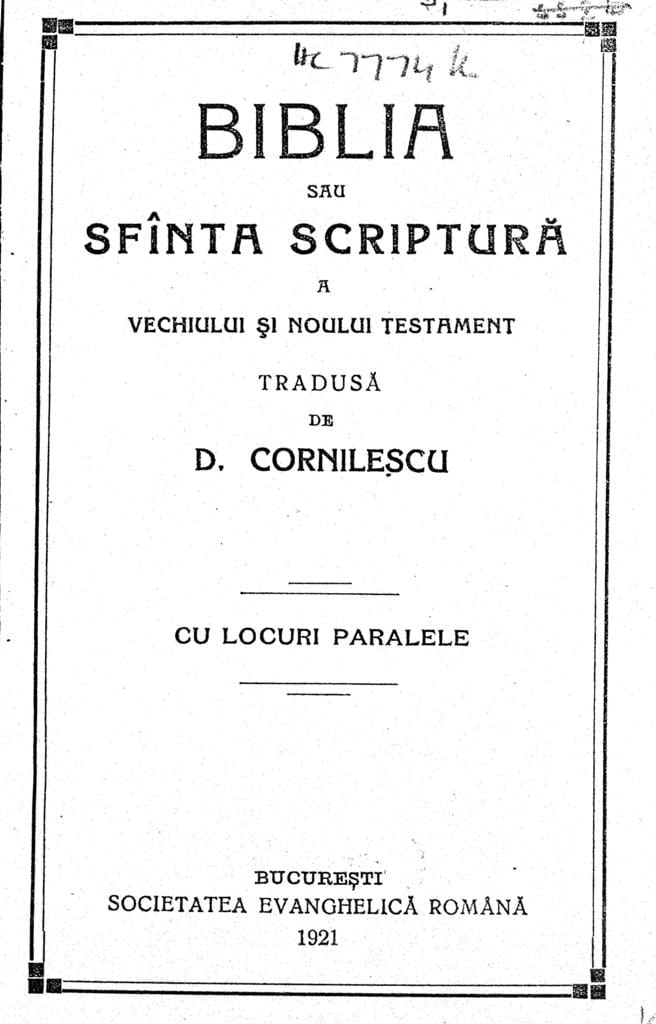
Cornilescu’s first complete Bible appeared in 1921. In 1924, a substantially revised edition followed in cooperation with the British and Foreign Bible Society. Further corrections in the years that followed helped stabilize the text. Both dates belong to the story: 1921 marks the first complete edition, and 1924 marks an important revision. 1, 3
Take a moment to look at the 1921 title page above. That’s the edition we’re talking about. Behind it were manuscripts to prepare, paper to pay for, and pages to correct.
People sometimes feel uneasy when the wording they grew up with changes. I understand why a familiar phrase matters. A careful revision can also be a way of serving the next reader, especially when spelling or everyday language has changed.
The small word that changes a sentence
Conțac points to Luke 1:45 as an example. A small word in Greek can change how the two parts of the sentence fit together. In his reading, the focus falls on what Mary believed: that the Lord would fulfill what He had told her. That differs from the causal wording shared by Segond and Cornilescu. 4
That’s easy to miss when we read quickly. Yet it’s worth slowing down: in this verse, the way a sentence is put together shapes how we hear the connection between Mary’s faith and God’s promise.
Most of us aren’t going to sit down with a Greek grammar every morning. But when a sentence puzzles us, we can compare another trustworthy translation, read the verses around it, or ask someone who’s studied the passage. These are good habits even when we love the Bible we already have.
A letter asking for a typewriter
There’s a letter from April 17, 1931 that I’m glad we still have. In it, Cornilescu says he’s lost Callimachi’s financial support, is struggling to make a living in Switzerland, and has pain in his right arm. He asks the Bible Society for a typewriter so he can work with his left hand. Pavy Beloiu reproduces the letter in his introduction to Cornilescu’s sermons. 6
Beloiu also describes Cornilescu’s later pastoral and leadership work at Ländli. His weekly preaching appeared in Unter dem Kreuz, and the collection preserves fifty-one sermons from 1938. He continued to serve long after the translation for which we remember him. 6
That request for a typewriter stays with me. A man whose work had served so many readers needed help himself. If you’re in a season when you can’t do what you used to do, asking for practical help may be part of how you keep serving.
Faithful translation requires more than enthusiasm
Conțac’s research shows how substantially Louis Segond’s French Bible influenced the text and notes of Cornilescu’s 1921 edition. He also shows where Cornilescu made different choices. The differences matter if we want to understand how he worked. 4
Much of that work is hidden from us when we read. Translators compare versions, wrestle with difficult phrases, and then make a choice they know other careful readers may question.
I can be thankful for Cornilescu without asking every Romanian phrase to bear the full weight of the original Hebrew or Greek. If an important conclusion seems to hang on one word, it’s worth looking at another translation and a reliable explanation.
That’s especially important before we teach something to others. We love Scripture well when we give the passage enough time to correct even our favorite reading of it.
Clear language can carry deep truth
Cornilescu’s work leaves me with a question as a pastor: when I explain Scripture, am I helping the person in front of me hear what God is saying?
In Nehemiah 8:8, the people hear God’s law read aloud, and its meaning is explained so they can understand it. I think about that when a young person hears a word in church that the rest of us have used for years. We may need to pause and explain it before we move on.
Explaining something simply often takes more work than repeating a familiar phrase. A teenager deserves the same truth as someone who has walked with Christ for decades, in words they can follow.
The next time you come to a difficult word, read the paragraph and try explaining it to someone in your own words. Keep the part that challenges you, too. That patient attention can be part of our fellowship with God through His Word.
Read the Bible beyond the translator’s reputation
I hope this story makes you want to open your Bible again. A translation may hold memories we’re grateful for, but there’s also something God’s Word can show us about the way we’re living today.
James 1:22–25 invites us to do what we hear. Maybe a passage will show you something you need to confess, a reason to trust Christ in a hard situation, or a way to speak more gently to someone at home.
Start with a whole paragraph. Who is speaking? To whom? What is the writer saying before and after the verse you noticed? If the wording is difficult, compare another reliable translation.
Then ask God to help you act on what the passage actually says. One concrete response is a good place to begin.
A legacy worth receiving responsibly
Cornilescu spent his later years in Switzerland, where he died in 1975. Thanks to the surviving 1974 interview and Conțac’s scholarly edition, we can still hear something of the man behind the familiar name. 1, 5
I’m grateful for the people who did the unseen work that made it easier for others to read Scripture. Their work is worth remembering, and it’s worth studying honestly.
This week, choose one short passage from a Gospel. Read it slowly, write down its main point, and talk it through with someone. Then take one step that makes sense in light of what you’ve read.
And when you open your Bible, take a moment to thank God for the people who helped put it in your hands. Then ask Him to help you hear and do what He says.
Sources and further reading
1. Bible text and edition history, Biblia Pentru Viață / SBIR copyright information
2. Emanuel Conțac, transcript and critical notes from Cornilescu’s 1974 interview
3. Publication chronology, Biblia Dumitru Cornilescu
4. Emanuel Conțac, comparative study of Segond and Cornilescu (2011)
6. Pavy Beloiu, introduction to the 1938 sermons, including Cornilescu’s letter of April 17, 1931
7. Voicu Bojan, Tocilarul, Prințesa și Cartea, PressOne (2024)
AI assistance disclosure: AI tools assisted with research organization and English-language editing. I am Romanian, and English is not my native language. Sources are listed above; the historical claims and pastoral reflections remain my responsibility.

I am a blogger, writer, pastor, Director of Zion Romania Bible School, husband to Olguta, a father and, most importantly, a child of God. I also completed my studies at the King’s University where I earned a B.A. in Theology with a concentration in Messianic Jewish Studies. I love Israel and I love the ‘Jewishness’ of the Bible.


Leave a Reply