
This post may contain affiliate links. If you decide to make a purchase through these links, I earn a small commission at no cost to you. I do not promote anything I do not believe in or stand behind.
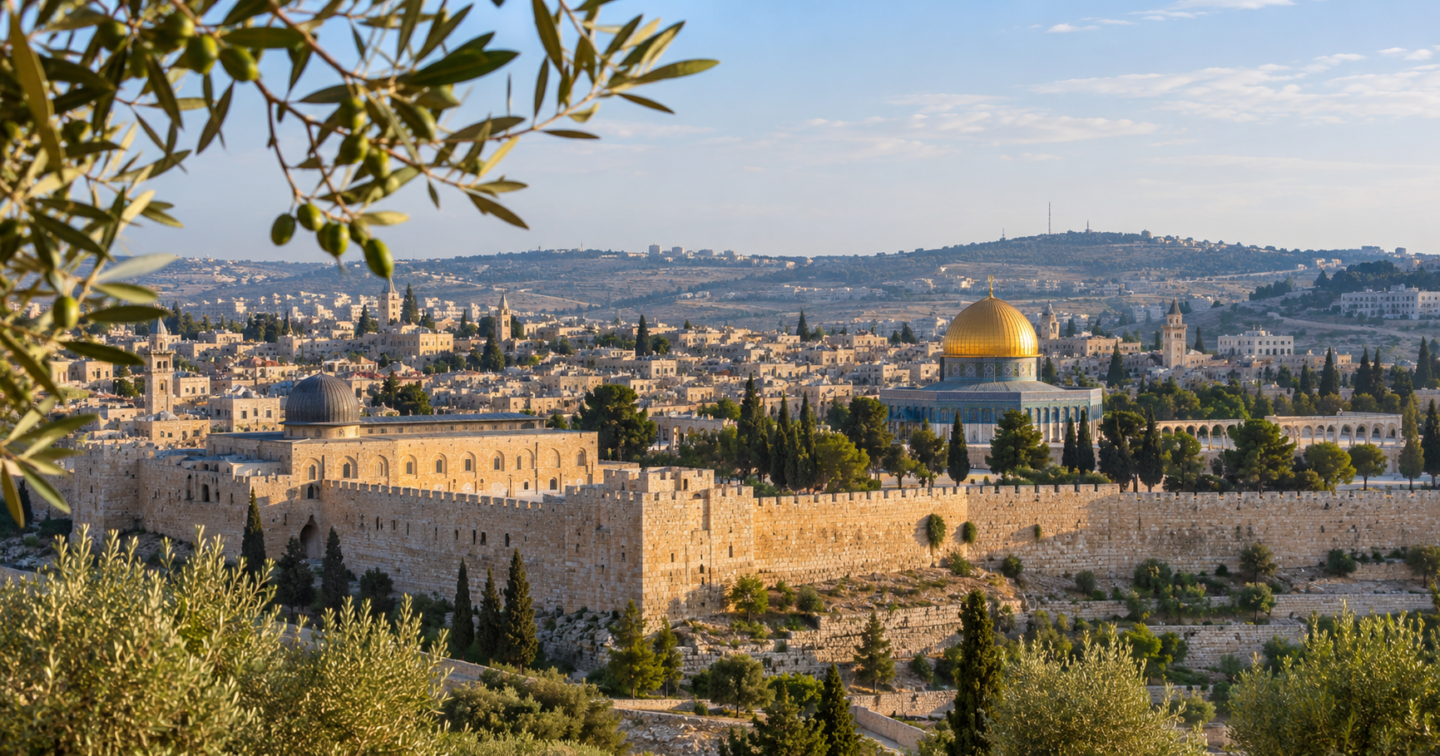
What makes the Holy Land holy? Is it God’s presence, His covenant promises, or something else? Did the resurrection of Jesus and the coming of the Holy Spirit at Pentecost bring an end to the distinctive holiness associated with the Land of Israel?
In a video featuring N. T. Wright, the influential Anglican theologian makes a striking statement:
With Jesus and the Spirit and the resurrection and Pentecost and the mission of the church, the whole world is now God’s holy land.
This is not an isolated remark. In his 1999 book, The Way of the Lord, Wright develops a similar argument, maintaining that the distinctive holy status of Israel’s land belonged to a preparatory stage in God’s redemptive purposes.
The coming of Jesus, in his understanding, brings that stage to its intended fulfillment.
As someone who approaches Scripture from a dispensational perspective, I recognize that my theological convictions must also remain open to examination. No theological system should be protected at the expense of biblical truth.
Therefore, rather than dismissing Wright’s argument, I want to examine it carefully. Where is he right? Where might his conclusions go beyond the biblical evidence?
What Does the Bible Mean by the Holy Land?
The precise Hebrew expression translated as “the holy land” occurs in Zechariah 2:12:
And the LORD shall inherit Judah his portion in the holy land, and shall choose Jerusalem again. (KJV)
The Hebrew expression is admat haqqodesh (אַדְמַת הַקֹּדֶשׁ), literally meaning the land or ground of holiness.
In this passage, it refers to a particular geographical territory associated with Judah and Jerusalem. The exact Hebrew construction occurs only here in the Hebrew Bible, although similar expressions appear elsewhere.
Zechariah was addressing the Jewish people following the Babylonian exile. Jerusalem was recovering, the temple was being rebuilt, and the people faced considerable uncertainty.
God promised to dwell among them.
However, something particularly interesting appears in the preceding verse. Zechariah 2:11 declares that many nations will join themselves to the Lord and become His people.
The passage brings together three promises:
- God will dwell in the midst of Zion.
- Many nations will join themselves to the Lord.
- God will again choose Jerusalem and take Judah as His inheritance.
Notice that the inclusion of the nations does not eliminate the particular reference to Judah and Jerusalem.
This observation does not settle how the prophecy is ultimately fulfilled in Christ. Nevertheless, it demonstrates that, within the original prophetic context, God’s universal purposes and His particular relationship with Israel are not mutually exclusive.
Interestingly, the New Testament never uses the expression “the Holy Land” as a designation for Israel. Yet this observation, by itself, does not determine whether the concept continues, changes, or reaches its fulfillment in another form.
What Makes a Place Holy?
The concept of holy ground appears much earlier in Scripture.
In Exodus 3:5, God tells Moses to remove his sandals because the ground on which he is standing is holy.
Interestingly, Moses is not standing in Canaan. He is at Horeb, in the wilderness.
The ground is identified as holy in the context of God’s revealed presence.
This establishes an important distinction. Even before the establishment of Israel’s sanctuary, God could reveal His presence outside the territory later occupied by Israel.
Nevertheless, Scripture also describes a distinctive relationship between God and the Land of Israel.
In Leviticus 25:23, God identifies Himself as the owner of the land. Numbers 35:33–34 connects the land’s purity with God’s presence among His people. Jeremiah 2:7 describes Israel’s sin as a defilement of God’s inheritance.
The holiness of the land is not presented as a magical quality of its soil. It is understood in relation to God’s ownership, His covenant purposes, and His presence.
This holiness also carries moral responsibilities.
The sins of the land’s inhabitants could defile it, as Leviticus 18:24–28 makes clear.
Therefore, identifying a territory as holy does not mean that its inhabitants are automatically righteous or that their actions necessarily receive God’s approval.
The prophets repeatedly confronted Israel’s idolatry, injustice, and disobedience.
Holiness brought greater responsibility, not immunity from judgment.
Did the Whole World Belong to God Before Pentecost?
Psalm 24:1 declares:
The earth is the LORD’S, and the fulness thereof; the world, and they that dwell therein. (KJV)
The entire earth belonged to God long before the incarnation, resurrection, or Pentecost.
Exodus 19:5–6 makes an especially important distinction. God declares His ownership of the whole earth while setting Israel apart as His treasured possession and a holy nation.
Admittedly, this passage speaks directly about the people rather than the geographical territory.
Nevertheless, it establishes a relevant theological principle: God’s universal ownership is compatible with particular consecration.
Other passages, including Leviticus 25:23 and Zechariah 2:12, apply particular language to the land itself.
The question, therefore, is not whether the whole world belongs to God. Scripture clearly teaches that it does.
The question is whether the coming of Christ brought an end to the distinctive holiness previously associated with the Land of Israel.
God’s universal ownership cannot, by itself, answer that question.
Jesus and the Geography of Worship
One of the strongest biblical arguments supporting Wright’s perspective appears in John 4:20–24.
The Samaritan woman asks Jesus about the proper location of worship. Should people worship on Mount Gerizim or in Jerusalem?
Jesus announces a coming hour when worship of the Father will no longer be defined by either of these two locations. True worshippers will worship the Father in spirit and truth.
This represents a profound development in the history of redemption. However, we must be careful not to misunderstand what changed.
Was God Previously Accessible Only Through a Sanctuary?
Even under the Mosaic covenant, people could pray to God, experience His presence, and receive His revelation outside the central sanctuary.
Solomon himself acknowledged this when he dedicated the temple:
Behold, the heaven and heaven of heavens cannot contain thee; how much less this house that I have builded? (1 Kings 8:27, KJV)
Furthermore, Solomon prayed that God would hear His people even when they were living in exile (1 Kings 8:46–50).
Daniel prayed in Babylon. Ezekiel received divine revelation among the exiles. David sought God in the wilderness.
None of them needed to be physically present in the temple for God to hear them.
At the same time, the temple remained significant. Solomon envisaged the exiles praying toward the land, Jerusalem, and the temple. Daniel likewise prayed with his windows open toward Jerusalem (Daniel 6:10).
These examples demonstrate that God’s accessibility outside the sanctuary was compatible with its continuing significance.
What Actually Changed Through Christ?
The Mosaic covenant established a central sanctuary for prescribed sacrifices, priestly ministry, pilgrimage festivals, and certain acts of worship (Deuteronomy 12:5–14; 16:16; Leviticus 16).
It did not restrict every personal encounter with God to that geographical location.
Through Christ, the sacrificial and priestly system reaches its fulfillment. Believers approach the Father through Jesus, whose once-for-all sacrifice provides the basis for confident access to God’s presence (Hebrews 9:11–14; 10:19–22).
Moreover, in John 2:19–22, the apostle explicitly identifies the body of Jesus as the temple.
John 4, therefore, announces a transformation of the established order of worship rather than the introduction of a previously unknown ability to encounter God outside a sanctuary.
This distinction is particularly important when evaluating Wright’s claim.
The removal of the requirement for a central geographical sanctuary does not, by itself, establish the removal of every distinctive aspect of Israel’s territorial holiness.
These questions are related, but they are not identical.
Did Pentecost Make the Whole World the Holy Land?
According to Wright, Pentecost belongs to the decisive events through which the whole world becomes God’s holy land.
But what does Luke actually describe?
Acts 2 records the coming of the Holy Spirit upon the gathered disciples. They were filled with the Spirit and began speaking as the Spirit enabled them.
Peter explains the event by quoting Joel’s prophecy concerning the outpouring of the Spirit upon all flesh.
The passage emphasizes the availability of the promised gift across distinctions of age, sex, and social status.
As Acts unfolds, the gift of the Spirit reaches Samaritans and Gentiles as well (Acts 8:14–17; 10:44–48).
Pentecost does not represent the beginning of all the Holy Spirit’s activity among human beings. The Old Testament already records His work in prophets, leaders, and others.
Rather, Pentecost inaugurates the promised outpouring of the Spirit associated with the messianic age and the worldwide mission of Jesus’ followers.
People or Geographical Territories?
Here we encounter an important distinction.
The Holy Spirit comes upon people. Luke does not describe the event as the geographical consecration of every territory on earth.
In Acts 10, for example, the Spirit comes upon Gentiles gathered in the household of Cornelius.
Peter subsequently interprets this event as evidence that God has granted Gentiles repentance leading to life (Acts 11:15–18).
The passage concerns the inclusion of people, not a declaration concerning the sacred status of the territory on which they stand.
The worldwide mission of the Church and the widening distribution of the Spirit’s gifts are clearly established.
Whether these developments also eliminate the distinctive holiness associated with a particular land requires further biblical argument.
Holy Ground in the Book of Acts
Another fascinating passage appears in Acts 7:33.
Stephen recounts Moses’ encounter with God at the burning bush, describing the location as holy ground.
The Greek expression is gē hagia (γῆ ἁγία).
Stephen’s speech emphasizes God’s activity in Mesopotamia, Egypt, and the wilderness. He also challenges any attempt to confine the Most High to buildings made by human hands (Acts 7:48–50).
These observations provide substantial support for Wright’s emphasis on God’s presence beyond geographical boundaries.
However, Stephen illustrates this truth primarily through events that occurred long before Pentecost.
God’s freedom to reveal Himself outside Israel was not a new development introduced by the coming of the Holy Spirit.
What About Jerusalem After Pentecost?
Acts also records the continued presence of Jewish followers of Jesus at the Jerusalem temple.
The believers gathered there (Acts 2:46). Peter and John went there at the hour of prayer (Acts 3:1). Paul later participated in purification rites connected with the temple (Acts 21:23–26).
These passages do not establish that the temple remained necessary for salvation or that its sacrificial system retained the same theological function after Christ.
Nevertheless, they caution against portraying Pentecost as an immediate rejection of every religious association with Jerusalem.
The transition described in Acts is more complex.
Does Romans 8 Teach That the World Is Now Holy Land?
Wright identifies Romans 8 as a central biblical foundation for his claim.
And there is much in Romans 8 with which I agree.
Paul teaches that Christian hope involves more than the salvation of individual souls. God’s redemptive purposes encompass the liberation of creation itself.
The Christian hope is not the permanent abandonment of the material world. It includes bodily resurrection and the renewal of creation.
Nevertheless, Paul carefully distinguishes present reality from future fulfillment.
In Romans 8:21, the Greek verb eleutherōthēsetai means “will be set free.” It is a future passive verb.
Creation is still groaning. Believers have received the firstfruits of the Spirit, but they are also waiting for the redemption of their bodies.
The final liberation remains future.
To be fair, Wright recognizes this distinction. In his essay The Holy Land Today, he explicitly acknowledges that creation continues to groan while awaiting its redemption.
We should not accuse him of believing that the present world has already attained its final redeemed condition.
Can Something Be Holy Before It Is Fully Restored?
We must also avoid making the opposite mistake.
The presence of corruption in the world does not, by itself, demonstrate that the world cannot be consecrated to God in some sense.
After all, Israel’s land was described as holy even though sin, suffering, and death existed within it.
Consequently, the future tense of Romans 8:21 cannot independently disprove Wright’s claim.
The more precise observation is that Romans 8 explicitly promises creation’s liberation, but it does not explicitly designate the present world as the Holy Land.
Nor does the passage directly address whether the geographical holiness associated with Israel has ceased.
Wright’s formulation is a theological interpretation of Romans 8 within a broader biblical framework. It should be evaluated as such, rather than treated as a direct statement made by Paul.
Does Expansion Necessarily Mean Cancellation?
Wright’s argument deserves to be considered within the wider biblical narrative.
God’s purposes have always extended beyond Israel.
In Genesis 12:3, God promises that all the families of the earth will be blessed through Abraham.
Psalm 2:8 describes the nations as the inheritance of God’s anointed king.
Isaiah 49:6 presents the Servant of the Lord as a light to the nations.
Wright rightly recognizes the universal dimension of these passages.
However, Isaiah 49:6 is particularly revealing. The Servant’s mission includes both the restoration of Israel and bringing salvation to the ends of the earth.
The text does not present the second responsibility as a rejection of the first.
This does not independently establish the precise geographical or historical form of Israel’s restoration. It does, however, challenge the assumption that particular restoration and universal salvation must exclude one another.
Abraham as Heir of the World
In Romans 4:13, Paul describes Abraham and his offspring in relation to the promise of inheriting the world.
The immediate context emphasizes justification by faith and the inclusion of believers beyond the boundaries of circumcision.
Nevertheless, the worldwide scope of the inheritance is important.
Does Paul understand the worldwide inheritance as replacing the particular geographical promise, or does he describe a wider inheritance that remains compatible with it?
The verse has been interpreted in both ways.
Its universal language is clear. The implications of that language for the continuing significance of Canaan require further investigation.
A Heavenly Country
Hebrews 11:8–16 provides another important argument in favor of Wright’s broader theological perspective.
Abraham lived in the land of promise as a foreigner, looking forward to a city whose builder and maker is God.
The patriarchs desired a better country, identified as a heavenly one.
Their ultimate hope clearly extended beyond possessing Canaan during their earthly lives.
Similarly, in Matthew 5:5, Jesus draws upon Psalm 37:11 when speaking of the meek inheriting the earth.
These passages support the argument that biblical inheritance cannot be reduced to territorial possession in the ancient Near East.
However, establishing a greater, ultimate inheritance is not necessarily the same as demonstrating that every earlier geographical commitment has ceased to have particular significance.
The latter conclusion requires its own exegetical justification.
David Rudolph’s Messianic Jewish Response
An important contribution to this discussion comes from Dr. David J. Rudolph, a Messianic Jewish New Testament scholar.
In his 2016 essay, Zionism in Pauline Literature, Rudolph directly engages Wright’s understanding of Israel and the worldwide people of God.
Rudolph examines Romans 4:13 against the background of Scripture and Second Temple Jewish literature. He argues that expectations of a worldwide inheritance could coexist with a distinctive relationship between Israel and its land.
This matters because it challenges the assumption that Paul’s language about worldwide inheritance would necessarily have communicated the termination of Israel’s particular inheritance to his original readers.
Rudolph returns to the subject in his 2023 contribution, A Messianic Jewish Response, published in God’s Israel and the Israel of God: Paul and Supersessionism.
In a footnote on page 117, he questions the assumption that when something receives additional meaning through the Messiah, its earlier significance must necessarily be invalidated.
He illustrates this with marriage.
In Ephesians 5:22–33, Paul uses marriage to illuminate the relationship between Christ and the Church. Yet the greater theological significance does not abolish marriage itself.
The analogy has an important limitation. Marriage is explicitly reaffirmed in the New Testament, whereas the continuing status of Israel’s territorial holiness is precisely the issue under investigation.
Moreover, Hebrews demonstrates that certain institutions do reach fulfillment in Christ in ways that bring their former functions to an end.
Rudolph’s illustration cannot independently prove the continuing holiness of Israel’s land.
What it does demonstrate is that receiving a greater meaning in Christ does not constitute a universal principle of cancellation.
The nature of fulfillment must be established in each individual case.
What Do Other Christian Theologians Say?
Wright is not alone in his interpretation. Theologians from several Christian traditions have developed similar arguments, while others have challenged them.
Their positions should not be treated as identical, even when they reach comparable conclusions.
G. K. Beale: A Worldwide Sanctuary
The Reformed biblical scholar G. K. Beale develops an extensive biblical theology of God’s dwelling place in The Temple and the Church’s Mission.
He understands Eden as an original sanctuary and traces the development of sacred space through Israel, the temple, Christ, the Church, and the new creation.
In his essay On the Expected Universalization of the Old Testament Land Promises, Beale argues that the land promises anticipated an inheritance encompassing the entire renewed creation.
He distinguishes the fulfillment inaugurated through Christ from its future physical consummation.
His argument provides a more extensive canonical foundation for universalization than the brief explanation offered in Wright’s video.
Oren R. Martin: A Baptist Perspective
Baptist theologian Oren R. Martin develops a similar understanding in Bound for the Promised Land.
Martin traces the land theme from Eden through Israel to its ultimate fulfillment in Christ and the new creation.
His book was published in the New Studies in Biblical Theology series, edited by D. A. Carson.
This does not establish Carson’s agreement with every aspect of Martin’s theology. Nevertheless, Martin’s work illustrates how a carefully developed evangelical biblical theology can reach conclusions different from those of dispensationalism.
His argument is also available in The Land Promise in Biblical Theology.
Craig S. Keener: The Spirit and Restoration
New Testament scholar Craig S. Keener, whose academic background includes Pentecostal theological education, emphasizes the relationship between the promised outpouring of the Spirit and Israel’s biblical expectation of restoration.
In his teaching on Acts 1:6–8, Keener distinguishes the Spirit’s present empowerment of Jesus’ followers from the future consummation of God’s kingdom.
This distinction is especially useful when considering Wright’s appeal to Pentecost.
However, Keener’s interpretation should not be taken as an explicit endorsement of the continuing geographical holiness of Israel. It concerns the relationship between restoration, the Spirit, and the mission of the Church.
The Pontifical Biblical Commission: A Catholic Perspective
A comparable trajectory of theological development appears in the Pontifical Biblical Commission’s 2001 document The Jewish People and Their Sacred Scriptures in the Christian Bible, particularly paragraphs 56–57.
The document acknowledges the original geographical character of the land promise while emphasizing its broader symbolic and eschatological significance in the New Testament.
This position is relevant to Wright’s interpretation, although it should not be confused with an exhaustive statement of Roman Catholic theology concerning sacred places.
Gerald McDermott: An Alternative Anglican Perspective
Anglican theologian Gerald McDermott challenges the conclusion that universal fulfillment necessarily eliminates the particular significance of Israel’s land.
In Why the Land Promises Belong to Ethnic Israel, he argues that the New Testament preserves a distinctive relationship between Israel and the land.
The disagreement between McDermott and Wright is particularly interesting because both come from the Anglican tradition.
Their different conclusions demonstrate that denominational identity alone does not resolve this exegetical controversy.
Darrell Bock: A Progressive Dispensational Perspective
Progressive dispensationalist Darrell Bock likewise recognizes the widening scope of God’s covenant blessings while maintaining that promises originally made to Israel retain particular significance.
In Israel’s Role in the Land Promise, Bock challenges the assumption that universal fulfillment requires the removal of specific commitments to Israel.
His argument is relevant to the question of territorial holiness, although the continuing validity of a land promise and the sacred status of a territory are not necessarily identical questions.
The distinction between these two concepts should remain clear.
A Hermeneutical Concern: Are We Asking the Text to Prove Too Much?
In his book Exegetical Fallacies, D. A. Carson identifies several errors relevant to this discussion.
One is the false dilemma: assuming that two ideas must exclude each other when they may actually be compatible.
Another concerns the failure to recognize important distinctions.
Throughout this discussion, at least five biblical concepts must remain distinct:
- God’s ownership of the entire earth.
- God’s ability to reveal His presence anywhere.
- God’s particular consecration of people and places.
- The indwelling presence and empowerment of the Holy Spirit.
- The future liberation and renewal of creation.
These concepts are related, but one cannot automatically be substituted for another.
Wright’s argument is strongest when understood as a broader biblical theology of fulfillment. Israel’s land, in his view, served as a preparatory sign pointing toward the reality inaugurated by Christ.
That interpretation deserves serious examination.
However, the argument requires us to establish that the land functioned exclusively as such a preparatory sign and that its distinctive holiness has consequently reached its intended conclusion.
The fact that other Old Testament institutions were transformed through Christ makes this interpretation possible. It does not independently establish that the land must follow precisely the same pattern.
The same standard must apply to dispensational theology.
The fact that Zechariah calls the land holy does not, by itself, demonstrate that its sacred status remains unchanged throughout every stage of redemptive history.
Nor does the absence of an explicit New Testament statement abolishing that status constitute conclusive proof of its continuation.
Both positions carry a burden of demonstration.
The Holy Land and the New Creation
Perhaps the clearest biblical picture of God’s ultimate purpose appears in Revelation 21–22.
John sees a new heaven and a new earth. God dwells among His people. Death, sorrow, and the curse are removed.
There is no separate temple in the New Jerusalem because God Almighty and the Lamb are its temple.
The cubic dimensions of the city also recall the dimensions of the Holy of Holies in Solomon’s temple (1 Kings 6:20).
These images provide substantial support for the theological understanding of the new creation as a comprehensive dwelling place of God.
At the same time, Revelation does not simply erase all the geographical and historical imagery associated with Israel.
The city is identified as the New Jerusalem. Its gates bear the names of the twelve tribes of Israel, while its foundations bear the names of the twelve apostles of the Lamb.
Interpreters disagree over how these images relate to the historical people and land of Israel.
Nevertheless, the vision reminds us that the biblical hope of universal redemption is not expressed through the abandonment of every image of particularity.
Above all, our ultimate hope is centered on Jesus the Messiah, not on a territory, a human government, or a political institution.
Has the Whole World Become the Holy Land? My Conclusion
I appreciate N. T. Wright’s emphasis on the resurrection, the presence of the Holy Spirit, the worldwide mission of the Church, and the restoration of creation.
These are essential biblical truths that Christians should recover wherever they have been neglected.
Furthermore, I recognize that his claim can legitimately function as a theological metaphor for the worldwide scope of God’s redemptive purposes.
In that sense, describing the whole world as God’s holy land can communicate something important about the new creation inaugurated through Christ.
However, when the expression is used to assert that Israel has necessarily lost its distinctive territorial holiness, the argument requires further exegetical demonstration.
God was never geographically confined.
The Old Testament already demonstrates that people could encounter Him outside Israel while the land retained its distinctive significance.
Through Christ, the prescribed sacrificial and priestly order of the Mosaic covenant reaches its fulfillment. Through Pentecost, the promised outpouring of the Spirit empowers Jesus’ followers for worldwide witness.
Romans 8 promises the future liberation of creation.
These truths are firmly grounded in Scripture. But whether they necessarily entail the termination of Israel’s particular territorial holiness remains a disputed theological question.
I am equally unwilling to assume that the land’s original holy status proves its unchanged continuation in every respect.
I also reject the idea that biblical holiness provides unconditional moral approval of a territory’s inhabitants or political authorities.
God’s holiness demands righteousness, justice, and obedience.
Ultimately, the question is not whether our preferred theological system survives the examination. The question is whether we have understood Scripture faithfully.
The universal scope of God’s redemptive purposes is not, by itself, proof that His particular commitments have ceased.
Their relationship must be established through careful biblical interpretation, with Jesus the Messiah at the center.
What do you think? Does the worldwide fulfillment of God’s promises necessarily bring an end to their particular significance for Israel?
If you would like to explore this subject further, I invite you to discover my book, The Land and the Promise: Israel and the Faithfulness of God, through my books page.
Sources and Further Reading
- Beale, G. K. The Temple and the Church’s Mission: A Biblical Theology of the Dwelling Place of God. IVP Academic, 2004.
- Beale, G. K. On the Expected Universalization of the Old Testament Land Promises. The Gospel Coalition, 2023.
- Bock, Darrell L. Israel’s Role in the Land Promise. The Gospel Coalition, 2023.
- Carson, D. A. Exegetical Fallacies. 2nd ed. Baker Academic, 1996.
- Keener, Craig S. Acts: An Exegetical Commentary. Baker Academic, 2012–2015. See also his lecture on Acts 1.
- Martin, Oren R. Bound for the Promised Land: The Land Promise in God’s Redemptive Plan. IVP Academic, 2015.
- Martin, Oren R. The Land Promise in Biblical Theology. Themelios.
- McDermott, Gerald R. Why the Land Promises Belong to Ethnic Israel. The Gospel Coalition, 2023.
- Pontifical Biblical Commission. The Jewish People and Their Sacred Scriptures in the Christian Bible. 2001, §§56–57.
- Rudolph, David J. “Zionism in Pauline Literature: Does Paul Eliminate Particularity for Israel and the Land in His Portrayal of Salvation Available for All the World?” In The New Christian Zionism, edited by Gerald R. McDermott, 167–194, especially 171–177. IVP Academic, 2016.
- Rudolph, David J. “A Messianic Jewish Response.” In God’s Israel and the Israel of God: Paul and Supersessionism, edited by Michael F. Bird and Scot McKnight, 103–129, especially 116–117. Lexham Academic, 2023.
- Wright, N. T. The Way of the Lord: Christian Pilgrimage in the Holy Land and Beyond. SPCK/Eerdmans, 1999, 119–130. Available online as The Holy Land Today.
Direct Scripture quotations are from the King James Version (KJV).

I am a blogger, writer, pastor, Director of Zion Romania Bible School, husband to Olguta, a father and, most importantly, a child of God. I also completed my studies at the King’s University where I earned a B.A. in Theology with a concentration in Messianic Jewish Studies. I love Israel and I love the ‘Jewishness’ of the Bible.

Leave a Reply