
This post may contain affiliate links. If you decide to make a purchase through these links, I earn a small commission at no cost to you. I do not promote anything I do not believe in or stand behind.
Imagine standing beside the apostle John on the island of Patmos.
Suddenly, heaven opens.
You see a Lamb who was slain. A dragon appears. Stars fall. Angels pour bowls upon the earth. Water becomes blood. The sun scorches humanity. An altar speaks.
Then someone hands you a Bible and asks:
“So… is all of this literal or symbolic?”
That question has divided Christians for generations.
Some readers treat Revelation almost like tomorrow’s newspaper. Others turn nearly every detail into a symbol. However, both approaches can miss something important.
If we want to understand how to interpret Revelation, we must stop asking only, “Is this literal or symbolic?”
Instead, we should ask:
What did John see, what does the image represent, and what truth does God intend to communicate through it?
That distinction can transform the way you read Revelation.
More importantly, it can help you see that this book was not written merely to satisfy curiosity about the future.
Revelation was given to strengthen believers who live in a broken world, face temptation, fight sin, suffer pressure, and need to remember one great truth:
Jesus Christ wins.
The Problem With “Literal vs. Symbolic”
Christians sometimes approach Revelation as if we only have two choices.
Either everything is literal.
Or everything is symbolic.
Yet the Bible itself does not work that way.
Jesus said:
“I am the good shepherd.” — John 10:11
Jesus is a real person.
Nevertheless, He is not telling us that He literally walks around carrying a shepherd’s staff while Christians physically grow wool.
The Person is literal.
The description is metaphorical.
Both appear in the same sentence without contradiction.
Likewise, Jesus told His disciples:
“You are the light of the world.” — Matthew 5:14
The disciples were real people.
“Light” functions metaphorically.
Therefore, interpreting one element literally and another symbolically does not automatically mean we are being inconsistent.
The real danger comes when we switch between literal and symbolic interpretations only because one interpretation fits our theological system better.
That is where careful Bible study matters.
A Better Rule for How to Interpret Revelation
Here is a principle worth remembering:
Hermeneutical consistency does not mean interpreting every detail in the same way. It means using the same sound principles to determine how each detail should be understood.
That changes everything.
We should not say:
“Because one element is symbolic, everything must be symbolic.”
Neither should we say:
“Unless the text explicitly tells me otherwise, everything must describe a physical object or event exactly as John saw it.”
Instead, we examine the context.
We consider the genre.
We look for Old Testament background.
We notice whether Revelation itself explains the symbol.
Most importantly, we ask what the author intends to communicate.
Consider Revelation 1.
John sees Jesus Christ with seven stars in His hand and a sharp sword coming from His mouth.
Jesus is real.
However, should we imagine the glorified Christ permanently walking around heaven with a metal sword sticking out of His mouth?
Probably not.
The image communicates something about the authority and power of Christ’s word.
In fact, Revelation itself explains some of its images.
The seven stars represent the angels of the seven churches, while the seven lampstands represent the churches.
Therefore, Revelation gives us a pattern:
Real persons and real truths can be revealed through symbolic images.
That brings us to Revelation 16.
Does the Altar Literally Speak in Revelation 16?
Revelation 16:7 contains a fascinating statement:
John hears the altar responding to God’s judgments.
An altar speaks.
Does that mean heaven contains a literal stone altar with vocal cords?
Of course, that is not what John wants us to conclude.
The altar is personified.
Yet some interpreters use this observation to make a larger argument.
They essentially say:
“If the altar speaking is symbolic, then we cannot suddenly interpret the sun scorching people in the following verses literally. We cannot jump between symbolic and literal whenever we want.”
The warning contains something valuable.
We should never manipulate Scripture to defend our preferred interpretation.
However, the conclusion can go too far.
Why?
Because a symbolic element in one part of a vision does not automatically make every other element symbolic.
Consider a simple statement:
“The nation wept, while thousands of people stood outside in the rain.”
“The nation wept” uses personification.
The people can still be literal.
The rain can still be real.
Nothing inconsistent happened.
Different elements perform different functions within the same description.
The same principle can operate in Revelation.
Why the Speaking Altar Matters
Interestingly, Revelation gives us context for the altar.
Earlier, in Revelation 6:9–10, John sees the souls of believers who had been killed because of their faithfulness to God.
Where are they?
Under the altar.
They cry out:
“How long?”
They want God to bring justice against evil.
Then we arrive at Revelation 16.
God pours out judgment.
The persecutors of God’s people face His justice.
After that, the altar declares that God’s judgments are true and righteous.
Do you see the connection?
In Revelation 6, the martyrs associated with the altar cry for justice.
Later, in Revelation 16, judgment comes.
Then the altar itself seems to answer:
God has done what is right.
The image becomes powerful when we connect the dots.
The altar does not need vocal cords.
Rather, it stands as a symbolic witness that the prayers of God’s suffering people have not been forgotten.
God heard them.
God remembered them.
God acted.
For every Christian man who has wondered whether faithfulness matters when evil seems to win, that truth should strengthen your heart.
God never forgets faithfulness to Christ.
What About the Sun Scorching People?
Immediately after the altar speaks, Revelation 16:8 says the fourth angel pours his bowl upon the sun.
Then the sun receives power to scorch people with fire.
Verse 9 describes people being scorched by intense heat.
So, is that literal?
The answer requires more care than a simple yes or no.
John is describing a vision.
Therefore, we should not treat Revelation as if John were writing a modern scientific report explaining atmospheric temperatures and solar activity.
Yet that does not mean the judgment is unreal.
In fact, Revelation 16 repeatedly echoes the plagues God sent upon Egypt.
Think about the pattern:
- painful sores
- water becoming blood
- darkness
- frogs
- devastating hail
These images remind us of Exodus.
Why?
Because Revelation presents God as the same sovereign Lord who once judged Pharaoh, rescued His people, and demonstrated that the gods of Egypt were powerless.
Now the final Exodus reaches a greater scale.
The Creator judges rebellious humanity.
Christ delivers His people.
Evil falls.
God reigns.
However, remember something important.
The plagues of Egypt were real.
Therefore, an event can carry deep symbolic meaning while still describing a real act of divine judgment.
Symbolism does not mean fantasy.
Symbolic Does Not Mean Unreal
This may be one of the most important principles for understanding Revelation.
A symbol can point to something completely real.
Consider Revelation 12.
John sees a great dragon.
Later, the text identifies that dragon as Satan.
The dragon is symbolic imagery.
Satan is real.
Likewise, Revelation portrays Jesus as a Lamb.
Jesus is not literally a farm animal.
Yet the crucified and risen Christ is absolutely real.
The symbol reveals truth about Him.
The Lamb points toward sacrifice, victory, redemption, Passover, and the cross.
Therefore, when learning how to interpret Revelation, we should distinguish three questions.
First: What does John see?
A dragon, a Lamb, a woman, stars, bowls, an altar.
Second: What does that image represent?
Satan, Christ, God’s people, judgment, worship, authority, or another reality.
Third: What truth does God communicate through that representation?
That final question often takes us toward the theological heart of the passage.
Creation Turns Against Rebellion
Now look again at Revelation 16.
Something remarkable happens.
Humanity has rebelled against the Creator.
People worship the Beast.
They embrace an anti-God system.
They refuse Christ’s authority.
Then creation itself becomes an instrument of divine judgment.
Water becomes judgment.
The sun becomes judgment.
The air becomes judgment.
The created world that humanity enjoys while rejecting its Creator suddenly reminds humanity who owns creation.
God does.
Psalm 24:1 says:
“The earth is the LORD’s, and everything in it.”
The sun does not belong to humanity.
The oceans do not belong to humanity.
The air does not belong to humanity.
Everything belongs to God.
Therefore, Revelation 16 gives us more than dramatic pictures of future judgment.
It confronts the human heart.
You cannot enjoy God’s creation forever while rejecting the God who created it.
Eventually, every created thing points back to its Maker.
The Most Terrifying Part of Revelation 16
The most frightening detail may not be the scorching heat.
It may be what happens inside the human heart.
Revelation 16:9 says the people recognize that God has power over these plagues.
Yet they do not repent.
Instead, they blaspheme Him.
Think about that.
They experience judgment.
They recognize God’s power.
Still, they refuse repentance.
Why?
Because evidence alone cannot soften a heart determined to resist God.
Sometimes we imagine that unbelief exists only because people lack enough information.
“If God would just show Himself clearly, everyone would believe.”
Revelation challenges that assumption.
People can encounter overwhelming evidence of God’s power and still hate His authority.
The deepest human problem is not merely ignorance.
Our deepest problem is sin.
Your Greatest Problem Is Deeper Than Your Behavior
Christian men need to hear this.
You may look at your spiritual struggles and think:
“My biggest problem is pornography.”
“My biggest problem is anger.”
“My biggest problem is lust.”
“My biggest problem is pride.”
“My biggest problem is fear.”
“My biggest problem is laziness.”
Those sins matter.
You should fight them seriously.
However, beneath sinful actions sits a heart that still needs the grace of Christ every day.
Even after conversion, Christians continue battling the flesh.
Salvation does not mean you suddenly become incapable of temptation.
Instead, God declares sinners righteous through faith in Jesus Christ, gives them His Spirit, and begins transforming them into Christ’s likeness.
Therefore, the Christian life is not:
“Jesus saved me because I finally became good enough.”
The Gospel says:
Jesus saves sinners who could never become good enough to save themselves.
Christ lived the righteous life we failed to live.
He carried our sin upon the cross.
He endured the judgment we deserved.
He rose from the dead.
Now everyone who trusts Him receives forgiveness, righteousness, adoption, and eternal life by grace.
You fight sin from acceptance in Christ, not for acceptance from Christ.
That distinction changes the battle.
Grace Does Not Make Sin Safe
At the same time, grace never gives Christians permission to make peace with sin.
The same Jesus who forgives us calls us to follow Him.
The Holy Spirit does not merely comfort us after failure.
He empowers us to pursue holiness.
Therefore, when temptation hits, do not only ask:
“How can I stop doing this?”
Ask deeper questions.
What am I believing right now?
What am I seeking from this sin?
Comfort?
Control?
Pleasure?
Escape?
Approval?
Then ask:
What does Christ offer that this sin falsely promises?
Now you are moving from cutting fruit to dealing with roots.
Five Principles for Reading Revelation Well
If you want to know how to interpret Revelation without getting trapped in endless speculation, use these principles.
1. Let Scripture Explain Scripture
When Revelation explains an image, start there.
Do not invent meanings when God has already given one.
2. Read Revelation With the Old Testament Open
Daniel, Ezekiel, Isaiah, Zechariah, Psalms, Genesis, and Exodus provide much of Revelation’s visual vocabulary.
Many strange images become clearer when you recognize their biblical background.
3. Respect Apocalyptic Language
Revelation contains visions, signs, symbols, numbers, cosmic imagery, and dramatic scenes.
Do not flatten that language into a technical report.
4. Remember That Symbols Can Describe Reality
A symbolic image does not make the reality behind it imaginary.
The dragon is symbolic.
Satan is real.
The Lamb is symbolic imagery.
Jesus is real.
Likewise, a vision of judgment may use symbolic imagery while pointing toward real divine judgment.
5. Keep Jesus at the Center
This principle matters most.
Revelation is not primarily a puzzle book for Christians obsessed with decoding headlines.
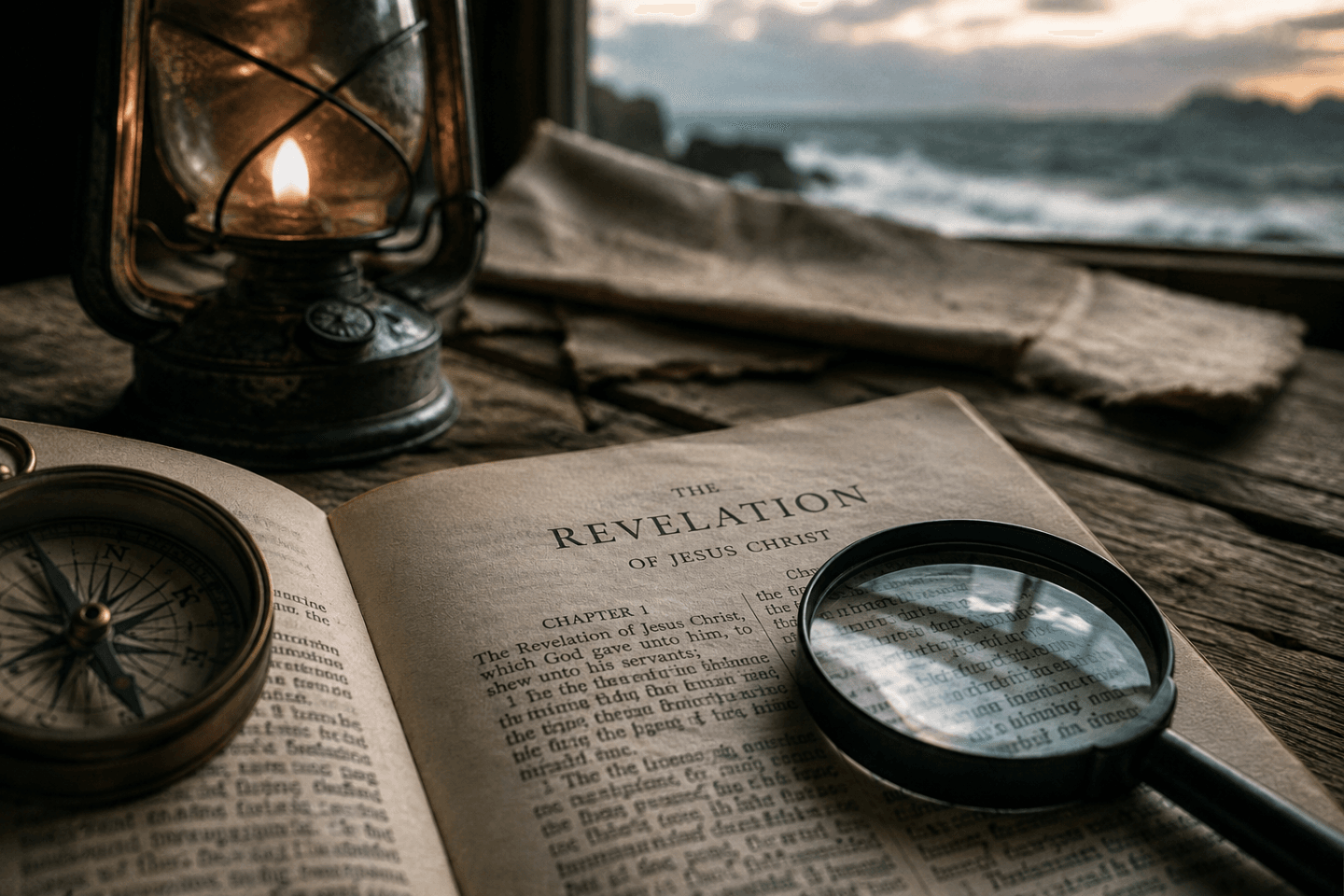
It is the Revelation of Jesus Christ.
The Lamb wins.
Babylon falls.
Satan loses.
Christ returns.
The dead rise.
Judgment comes.
God dwells with His people.
Every tear disappears.
Therefore, if your interpretation produces endless speculation but makes Jesus smaller, something has gone wrong.
Revelation Was Written to Produce Faithfulness
Imagine being a Christian living under pressure in the first century.
Rome looks unstoppable.
The emperor appears powerful.
Christians suffer.
Some lose jobs.
Others face rejection.
Some die for their faith.
Then Revelation pulls back the curtain.
Rome is not ultimate.
The Beast is not ultimate.
Satan is not ultimate.
Your suffering is not ultimate.
Jesus is Lord.
Suddenly, Revelation stops being merely a timeline.
It becomes a call to endurance.
That message still matters today.
Maybe your battle does not involve Roman persecution.
Perhaps your battlefield is your bedroom at midnight when temptation hits.
Maybe it is your office when compromising your integrity could advance your career.
Perhaps it is your marriage when anger begins boiling inside.
Maybe you feel spiritually tired and wonder whether continuing to obey Jesus is worth the struggle.
Revelation answers:
Yes.
Keep going.
The Lamb wins.
Do Not Make Peace With What Jesus Will Destroy
Revelation gives Christian men a powerful reason to fight sin.
Everything opposed to Christ will eventually fall.
Satan will fall.
Babylon will fall.
The Beast will fall.
Death will fall.
Sin will disappear.
Christ will reign openly.
So why build your life around something Jesus is going to destroy?
Why feed what Christ calls you to crucify?
Why protect secret sin when Jesus offers freedom?
You will stumble.
You may lose battles.
You may have days when your faith feels painfully weak.
However, your salvation rests upon Christ’s finished work, not your flawless performance.
Therefore, get up again.
Confess quickly.
Repent sincerely.
Open your Bible.
Pray.
Ask the Holy Spirit for strength.
Talk to mature Christian brothers.
Stay connected to your local church.
Bring hidden battles into the light.
Most importantly, keep looking to Jesus.
The Question Revelation Leaves With Us
We began by asking:
Is Revelation literal or symbolic?
Perhaps now you can see why that question alone is too small.
The better question is:
What reality does God want me to see through these images?
Revelation 16 shows us a God who judges evil righteously.
It shows us that creation belongs to its Creator.
It reveals the frightening hardness of the sinful human heart.
Yet the whole book also points us toward the Lamb who was slain.
Jesus Christ bore judgment for sinners.
The Judge became our Savior.
The Lamb died.
The Lamb rose.
The Lamb reigns.
And the Lamb is coming again.
Therefore, Christian man, do not read Revelation merely to discover what happens next.
Read it to discover who reigns now.
Then live accordingly.
Follow the Lamb
If you are fighting sin, temptation, discouragement, or spiritual compromise today, remember this:
Your battle has an ending.
Jesus has already won the decisive victory through the cross and resurrection, and the day is coming when every enemy will finally fall.
Until then, remain faithful.
Fight sin by the power of the Holy Spirit.
Stay rooted in Scripture.
Stay connected to Christ’s church.
And when you fall, run toward Jesus rather than away from Him.
The Lamb wins. So keep following the Lamb.
Do you agree?
Let me know if there is anything special going on in your life or if you want prayer! Share this post with your friends and don’t forget to leave a comment.
P.S. Whenever you use the links and the banners on my blog to buy something on Amazon USA, or you use other affiliate links on my blog, I receive a small commission at no cost to you. I do not promote anything I do not believe in or stand behind.

I am a blogger, writer, pastor, Director of Zion Romania Bible School, husband to Olguta, a father and, most importantly, a child of God. I also completed my studies at the King’s University where I earned a B.A. in Theology with a concentration in Messianic Jewish Studies. I love Israel and I love the ‘Jewishness’ of the Bible.

Leave a Reply