
This post may contain affiliate links. If you decide to make a purchase through these links, I earn a small commission at no cost to you. I do not promote anything I do not believe in or stand behind.
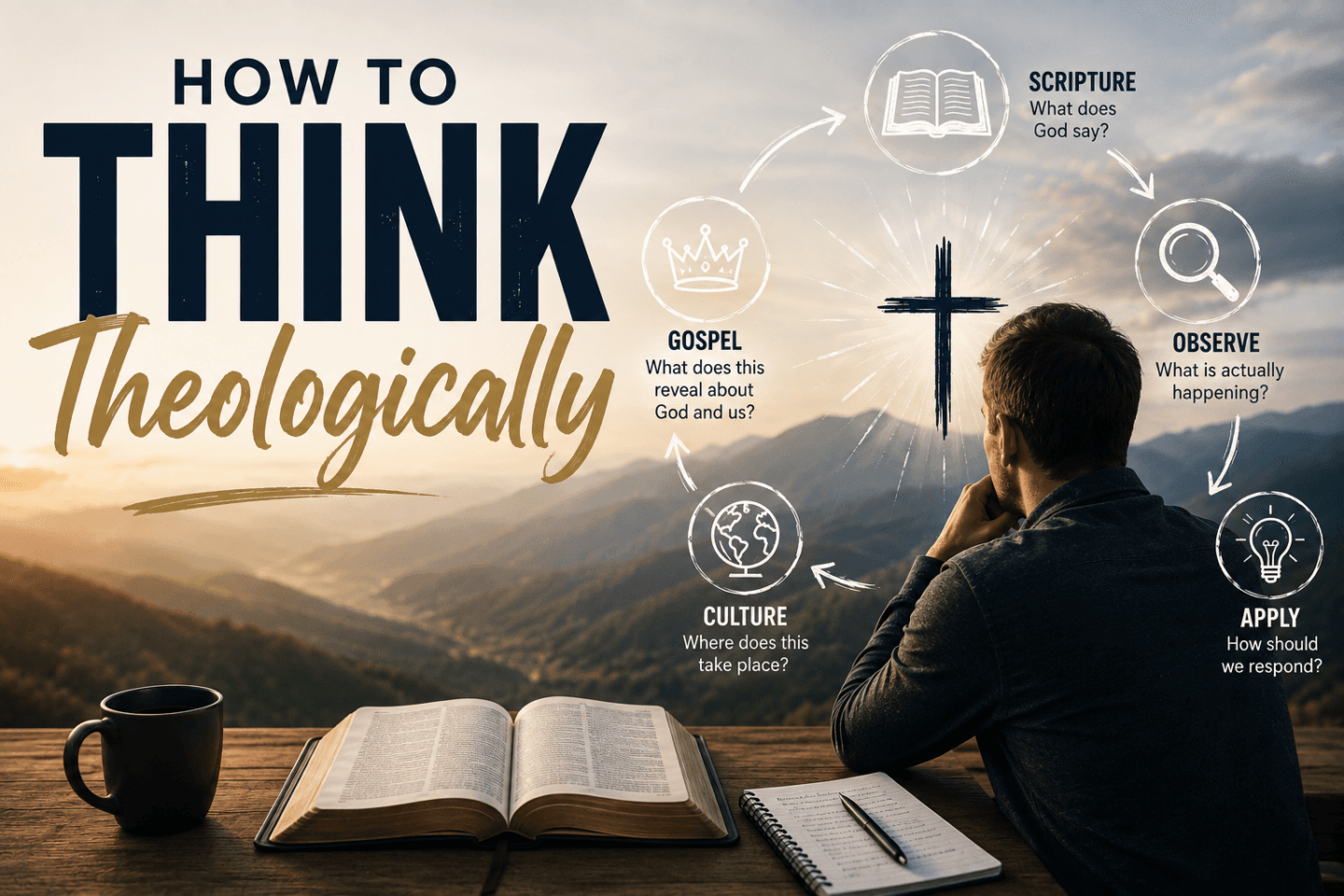
Learning how to think theologically is like standing in a dark room holding a flashlight.
You can see a chair.
Part of a wall.
Maybe a door.
Everything illuminated by the flashlight looks real. Yet you cannot see the whole room.
That is often how we make decisions.
We see what happened.
We know how we feel.
We hear what friends say.
Perhaps we watch a thirty-second video online.
Then we quickly conclude:
“This is right.”
Or:
“This is wrong.”
But what if we are looking at only one corner of the room?
Christians are called to something deeper.
We are called to think theologically.
That does not mean becoming a seminary professor or using complicated theological vocabulary.
Instead, theological thinking means learning to see ordinary life through what God has revealed in Scripture, especially through the gospel of Jesus Christ.
If Jesus is Lord, His lordship cannot stop at the church door.
It reaches our marriages, sexuality, money, work, politics, suffering, entertainment, relationships, phones, and decisions.
So how do we learn to think this way?
Here are seven practical steps.
What Does It Mean to Think Theologically?
To think theologically means asking what a situation reveals about God, humanity, sin, grace, Christ, and faithful Christian living.
It begins with Scripture.
However, biblical thinking involves more than finding a verse containing the same word as our problem.
We need to understand what Scripture actually teaches.
Then we apply that truth faithfully to the situation before us.
Romans 12:2 connects transformation with the renewing of our minds so that we can discern what pleases God.
Therefore, theology is not merely information stored in our heads.
It reshapes how we see reality.
Good theology eventually becomes lived theology.
1. Describe: What Is Actually Happening?
Suppose a friend tells you:
“My marriage is miserable. I don’t feel anything anymore. God wants me to be happy, so maybe I should leave.”
How do you respond?
You could immediately quote a verse.
You could condemn him.
Perhaps you agree with him.
But first ask:
What is actually happening?
What does “miserable” mean?
Is there abuse?
Adultery?
Constant conflict?
Emotional distance?
Selfishness?
Unrealistic expectations?
Depression?
Something completely different?
Proverbs 18:13 warns about answering before listening.
Therefore:
Describe before you diagnose.
This matters especially in pastoral counseling.
If abuse or immediate danger is involved, for example, the response will not be identical to ordinary marital conflict.
Biblical truth does not require ignoring facts.
Because truth matters, reality matters.
2. Think Theologically by Identifying Hidden Beliefs
Now return to your friend’s statement:
“God wants me to be happy.”
That sentence already contains theology.
It says something about God.
Perhaps underneath it lies an assumption:
“God’s main purpose is to maximize my immediate happiness.”
Or:
“If obedience hurts, God probably cannot be asking it of me.”
This is sometimes called embedded theology—beliefs operating underneath our words and decisions.
Imagine an iceberg.
Above the water you see:
“I want to leave.”
Under the surface may be beliefs such as:
“My feelings determine what is true.”
“My happiness is more important than covenant.”
“God would never ask me to suffer.”
“My life ultimately belongs to me.”
Every one of us carries assumptions.
Therefore, before making an important decision, ask:
“What am I believing about God right now?”
For situations involving suffering, this same principle helps us examine how we interpret hardship:
3. Think Theologically Through Three Biblical Lenses
Once we identify the beliefs underneath the situation, we need to test them.
Three lenses are especially helpful:
the gospel,
the human condition,
and
Christian calling.
These are not replacements for studying Scripture.
Rather, they help us organize biblical questions.
Lens One: The Gospel
Ask:
What has God done in Jesus Christ, and how does that change this situation?
Christianity does not begin with:
“Try harder.”
It begins with an announcement.
God has acted.
Jesus came.
He lived in perfect obedience.
Christ died for sinners.
He rose from the dead.
He reigns as Lord.
Now He calls sinners to repent and believe.
Suppose someone deeply hurts you.
Your first thought may be:
“How can I make him pay?”
Then the gospel enters the situation.
You remember that you also stood guilty before God and received mercy through Christ.
That does not eliminate justice.
Neither does forgiveness require pretending evil never happened.
However, grace changes the person asking the question.
The gospel does not merely give us different answers.
It changes us.
For a fuller explanation:
Lens Two: The Human Condition
Ask:
What does Scripture teach about the human heart in this situation?
Human beings possess enormous dignity because we are created in God’s image.
Yet Scripture also refuses to flatter us.
We are fallen sinners.
Therefore, our desires are not infallible guides.
We can rename sin:
greed becomes “ambition,”
lust becomes “love,”
pride becomes “confidence,”
cowardice becomes “wisdom,”
and rebellion becomes “freedom.”
Strong feelings do not automatically prove that something is God’s will.
Consequently, Christians need truth outside themselves.
The Holy Spirit renews believers, exposes sin, produces fruit, and increasingly conforms us to Christ.
Therefore, ask not only:
“What do I feel?”
Ask:
“What does Scripture reveal about the human heart here?”
Lens Three: Christian Calling
Ask:
How should someone who belongs to Jesus respond?
Notice the difference.
Not:
“What can I get away with?”
Not:
“What is everybody else doing?”
Instead:
“What response fits someone who belongs to Christ?”
Suppose someone attacks you online.
Perhaps you can destroy his argument.
You may even have the facts on your side.
Yet another question matters:
“What kind of person is Jesus calling me to be while I speak the truth?”
Christians have been called to follow Christ in all of life.
Our speech matters.
Our relationships matter.
Our work matters.
Even our social-media behavior matters.
If Jesus is Lord, every area of life falls under His authority.
4. Analyze: Test Your Conclusion
Now suppose you think you know the answer.
Do not rush.
Test it.
Ask first:
What does Scripture actually say?
That is different from asking:
“Can I find a verse that sounds like my opinion?”
Christians sometimes decide what they want to believe and then search Scripture for supporting sentences.
That is proof-texting.
We should do the opposite.
If Scripture is God’s Word, we do not stand over it as judges.
Scripture stands over us.
Read verses in context.
Consider the argument of the passage.
Compare Scripture with Scripture.
Then learn from mature believers and from the Church’s long history of theological reflection.
Tradition is not infallible.
Experience is not infallible.
Reason is not infallible.
Your favorite preacher is not infallible.
Scripture remains the supreme authority.
How to Think Theologically Without Proof-Texting
Imagine shopping in a supermarket.
You walk past twenty boxes and choose only the one that matches your taste.
Christians can treat Scripture the same way.
We ignore difficult passages.
Find one verse supporting what we already believe.
Then put it in our theological shopping cart.
Instead, ask:
What did the biblical author mean?
What comes before and after the verse?
What problem is being addressed?
How does this text fit within the larger biblical story?
Then ask how that truth applies today.
This order matters:
interpretation first, application second.
Otherwise, we may confidently apply something Scripture never actually taught.
For more on careful biblical study:
How the Holy Spirit Helps You Think Theologically
Biblical discernment is not merely an intellectual exercise.
We need the Holy Spirit.
Jesus calls Him the Spirit of truth.
The Spirit illuminates Scripture, convicts believers of sin, produces Christlike fruit, and helps God’s people walk faithfully.
However, the Holy Spirit does not compete with the Word He inspired.
Therefore, impressions should be tested rather than treated as automatically divine.
Pray:
“Holy Spirit, show me where my desires, fears, pride, or cultural assumptions are shaping my conclusions more than Scripture.”
That can be an uncomfortable prayer.
Yet it is a healthy one.
Humility allows us to admit:
“I may be wrong.”
For more on testing spiritual guidance:
5. Frame: What Best Explains the Situation?
Now bring everything together.
You have:
examined the facts,
identified hidden assumptions,
considered the gospel,
thought about the human heart,
searched Scripture,
listened to wisdom,
and prayed.
Now ask:
“What theological understanding best explains what is happening?”
Think of adjusting a camera lens.
At first the picture is blurred.
Then details become clearer.
Perhaps your first conclusion changes.
That is not failure.
Sometimes spiritual maturity sounds like:
“I was wrong.”
The goal is not to defend our first opinion.
The goal is to submit our thinking to Christ.
6. Judge: Which Response Is Most Faithful?
Eventually, reflection must lead to a decision.
Imagine standing at a crossroads.
You have studied the map.
Checked the signs.
Asked for directions.
Eventually you must choose a road.
Ask:
“Based upon Scripture and everything I now understand, which response appears most faithful to Jesus?”
You will not always make perfect decisions.
Therefore, humility remains necessary.
Nevertheless, fear of making a mistake cannot become an excuse for ignoring something Scripture clearly commands.
Notice the controlling question.
Not:
“Which path is easiest?”
But:
“Which path is most faithful?”
Sometimes those answers will be the same.
Often they will not.
7. Respond: Put Theology Into Action
Finally:
act.
Theology belongs in real life.
Perhaps you need to repent.
Forgive.
Apologize.
Confess hidden sin.
Set a boundary.
Ask someone for help.
Serve.
Speak.
Remain silent.
Change a habit.
Make restitution.
James warns Christians not merely to hear God’s Word but to do it.
Therefore, theological thinking eventually reaches your hands, mouth, calendar, relationships, and decisions.
Theology walks.
Theology speaks.
Theology forgives.
Theology repents.
Theology worships.
Theology serves.
What you truly believe about God eventually appears in how you live.
Think Theologically Before Your Next Decision
One question can help expose many bad decisions:
“What am I believing about God right now?”
When culture says:
“Everybody knows…”
ask:
“Why?”
When your heart says:
“I deserve this…”
ask:
“According to what?”
Even when someone says:
“The Bible clearly teaches…”
ask:
“Where?”
Then study the passage.
Not because Christians should doubt everything.
Rather, our confidence should rest on truth.
The goal is not suspicious Christianity.
The goal is biblical discernment.
Putting the Seven Steps Together
The next time you face a difficult decision, remember this movement:
1. Describe — What is actually happening?
2. Identify — What beliefs are hiding underneath?
3. Test — What do the gospel, human condition, and Christian calling reveal?
4. Analyze — What does Scripture actually teach?
5. Frame — What theological understanding best explains the situation?
6. Judge — Which response appears most faithful to Christ?
7. Respond — What should I now do?
You do not need complicated terminology.
Remember:
See clearly.
Dig deeper.
Look to Christ.
Know the human heart.
Submit to Scripture.
Ask what faithfulness requires.
Then act.
Mistakes to Avoid When Thinking Theologically
This process is helpful, but it is not infallible.
Avoid several common mistakes.
Do not assume your strongest feeling must be God’s voice.
Do not choose a verse before understanding its context.
Avoid using “peace” as the only test of a decision.
Do not assume hardship automatically means you chose wrongly.
Likewise, do not make a major decision only because one trusted Christian agrees with you.
Seek wisdom, but remember that human counselors can be mistaken.
Most importantly, do not confuse:
“This is what I want”
with:
“This is what God has revealed.”
A biblical decision grows from Scripture, wisdom, prayer, humility, and faithful obedience.
How to Think Theologically in Everyday Life
If Jesus Christ really is Lord, theology cannot merely tell us what to believe on Sunday.
It must teach us how to see Monday.
Your marriage.
Money.
Sexuality.
Career.
Politics.
Suffering.
Relationships.
Screen.
Anger.
Future.
Everything.
Perhaps the greatest danger is not that Christians have no theology.
Everyone carries beliefs about God, humanity, truth, good, evil, and meaning.
The danger is that we may never examine where those beliefs came from.
Scripture?
Culture?
Fear?
Pain?
Desire?
Social media?
Family tradition?
A favorite preacher?
Therefore, before your next important decision, ask:
“Is what I believe here actually true according to Scripture?”
Then bring that belief into the light of the gospel.
Because when Christ changes the way you see, He also begins changing the way you live.
Think Theologically This Week
Choose one real decision you currently face.
Walk through the seven steps.
Do not begin with:
“What do I want?”
Begin with:
“What is actually true?”
Then ask:
“What has God revealed?”
“How does the gospel change the way I see this?”
“What response would be faithful to Jesus Christ?”
Write your answers down.
Pray over them.
Study the relevant Scriptures in context.
Ask a mature believer for wisdom when needed.
Then act faithfully on what you know.
Learn how to think theologically because your beliefs are already shaping your decisions. The question is whether those beliefs are being shaped by Scripture and by Jesus Christ.
Continue Growing in Biblical Discernment
For understanding the gospel:
For being led by the Holy Spirit:
For testing Holy Spirit promptings:
For making godly decisions:
For responding to hardship:

I am a blogger, writer, pastor, Director of Zion Romania Bible School, husband to Olguta, a father and, most importantly, a child of God. I also completed my studies at the King’s University where I earned a B.A. in Theology with a concentration in Messianic Jewish Studies. I love Israel and I love the ‘Jewishness’ of the Bible.

[…] How to Think Theologically: 7 Steps for Biblical Decisions […]