
This post may contain affiliate links. If you decide to make a purchase through these links, I earn a small commission at no cost to you. I do not promote anything I do not believe in or stand behind.
How do you do a biblical word study without knowing Greek or Hebrew?
You may have opened your Bible, noticed an important word, and wondered:
“What does this word really mean?”
Perhaps you are preparing a sermon.
Maybe you are leading a Bible study.
Or you simply want to understand Scripture more carefully for yourself and your family.
A biblical word study can be extremely helpful.
However, it can also mislead us when we treat dictionaries, Strong’s numbers, or Greek and Hebrew definitions as shortcuts to hidden meanings.
Imagine standing in a dark room with a flashlight.
You notice a door.
Then you open it and discover an entire room behind it.
A word study can work like that.
One carefully examined word may help you notice something important in a passage.
Yet the word itself is never the whole house.
Context remains the house.
Therefore, the goal of a biblical word study is not to discover secret meanings unavailable to ordinary Bible readers.
Instead, it is to understand more accurately how a biblical author is using a particular word in a particular context.
Here is a simple seven-step method.
Why Learn How to Do a Biblical Word Study?
Words matter because God chose to reveal His truth through human language.
Biblical authors wrote real words in particular historical situations.
Therefore, paying attention to language helps us read Scripture carefully.
A good word study can help you:
- understand difficult passages;
- prepare clearer sermons;
- recognize repeated themes;
- distinguish similar ideas;
- avoid interpreting English wording too quickly;
- compare how an author uses a term elsewhere;
- appreciate nuances that translations cannot always reproduce.
However, word studies have limits.
A word does not carry every possible dictionary definition every time it appears.
For example, the English word bank can describe a financial institution or the side of a river.
If someone says:
“I deposited money at the bank,”
the riverbank meaning does not secretly exist inside that sentence.
Context selects the relevant sense.
Biblical languages work the same way.
That principle will protect you from many mistakes.
Step 1: Choose an Important Word From the Passage
Do not study every word.
Start with words that seem especially significant.
Look for:
- repeated terms;
- theological words;
- unusual expressions;
- contrasts;
- commands;
- words that affect the argument;
- terms you do not clearly understand.
Suppose you are studying Philippians 3:12:
“I press on to make it my own…”
The phrase “press on” deserves attention because it contributes directly to Paul’s picture of pursuing the goal.
Likewise, if a passage repeatedly uses words such as holy, faith, justify, abide, or glory, investigation may help.
However, do not choose a word simply because its Greek equivalent sounds impressive.
Ask first:
“Does understanding this word actually help me understand the author’s message?”
If not, leave it alone.
How to Do a Biblical Word Study: Start With the English Context
Before opening a lexicon, concordance, or Bible software, read the passage several times.
Start with the paragraph.
Then read the chapter.
Afterward, consider the larger argument of the book.
Ask:
Who is speaking?
To whom?
What problem is being addressed?
What comes before this statement?
What comes after it?
This step matters because context normally tells you more about a word’s meaning than its dictionary entry alone.
For example, if Paul uses the same Greek word differently in two contexts, the surrounding argument determines which sense is intended.
Therefore, never begin a word study by asking:
“What does Strong’s say?”
Begin with:
“What is this author saying here?”
Step 2: Compare Several Bible Translations
Different translations can function like windows.
If several translations use the same English word, interpretation may be straightforward.
However, when translations differ significantly, that often signals something worth examining.
Compare reliable translations such as:
ESV,
NIV,
NASB,
CSB,
NET,
NKJV,
or another trustworthy translation you regularly use.
Suppose one translation says:
“flesh”
while another says:
“sinful nature.”
That difference tells you translators are interpreting an underlying term with a broad range of possible uses.
Therefore, investigate further.
Translation comparison does not replace Greek or Hebrew study.
Still, it is one of the easiest ways for ordinary Christians to notice where deeper study may be useful.
How to Do a Biblical Word Study With Strong’s Numbers
Strong’s Concordance can be helpful.
However, use it as a starting tool, not as the final authority.
A Strong’s number helps you identify the underlying Hebrew or Greek word.
From there, you can examine where that word occurs elsewhere.
For example, Philippians 3:12 uses the Greek verb diōkō.
The same verb can describe:
pursuing something,
following after something,
or even persecuting someone,
depending upon context.
That does not mean Paul intends every one of those ideas in Philippians 3:12.
Instead, seeing the broader range helps us understand the semantic possibilities.
Then context determines the intended meaning.
That distinction is essential.
A word study asks:
“Which meaning fits here?”
It does not ask:
“How many definitions can I squeeze into this verse?”
Step 3: Look Up the Word in a Reliable Lexicon
A lexicon is essentially a dictionary designed for Greek or Hebrew.
Good lexicons organize meanings according to actual usage.
For ordinary Bible study, tools integrated into Bible software can be very helpful.
You might use:
- Logos Bible Software;
- Accordance;
- BibleHub;
- Blue Letter Bible;
- STEP Bible;
- lexicons available through your study Bible or software.
Nevertheless, remember one principle:
The lexicon gives possible senses. The passage determines the sense actually being used.
Imagine looking up the English word run.
It can mean:
run physically,
run a company,
run a computer program,
or water running from a faucet.
A dictionary lists possibilities.
Yet only context tells you which meaning appears in a sentence.
Biblical Greek and Hebrew are no different.
How to Do a Biblical Word Study Without Knowing Greek or Hebrew
You do not need to become a Greek or Hebrew scholar before you can benefit from word studies.
However, humility becomes even more important when you are using tools for languages you do not know.
Software makes finding Greek words easy.
Understanding Greek grammar is another matter.
Therefore, avoid saying:
“The Greek literally means…”
unless you genuinely know that the claim is justified.
Likewise, do not assume that finding an impressive lexical definition makes you more accurate than the translators.
Translation teams often include scholars who have spent decades studying these languages.
Use original-language tools to deepen your understanding.
Do not use them to create secret meanings that every major translation somehow missed.
That attitude keeps word study both useful and humble.
Step 4: Trace How the Word Is Used
Now examine other occurrences.
Start close to the passage.
Use this order:
- the immediate paragraph;
- the same chapter;
- the same biblical book;
- other writings by the same author;
- the same Testament;
- the broader biblical canon.
Why this order?
Because an author may use a word with a particular emphasis.
For example, John’s use of words such as life, believe, world, or abide becomes clearer when we examine how those terms function throughout John’s Gospel.
Likewise, Paul’s theological vocabulary develops through his letters.
However, do not assume one word must always carry exactly the same meaning.
Authors can use the same term differently according to context.
The goal is not finding identical definitions.
Rather, we are tracing usage.
How to Do a Biblical Word Study Without the “Root Fallacy”
Another common mistake is assuming a word’s original components determine its meaning.
English shows why this fails.
A butterfly is not a fly made of butter.
Understanding the separate words butter and fly does not tell you what butterfly means.
Similarly, Greek compounds cannot always be interpreted by breaking them into pieces and combining the pieces.
Meaning comes primarily from how speakers and writers actually use a word.
Therefore, be cautious when you hear:
“This Greek word comes from these two smaller words, so it literally means…”
Sometimes the observation is useful.
Often it is misleading.
Usage beats clever etymology.
Step 5: Determine What the Word Means in This Passage
Now the most important step arrives.
After examining possible meanings and other occurrences, return to your passage.
Ask:
Which meaning best fits this sentence?
Then ask:
Why?
Your answer should come from evidence in the context.
Look for:
grammar,
contrast,
parallel ideas,
the author’s argument,
historical situation,
and surrounding verses.
Do not choose the most exciting definition.
Choose the one that best explains the text.
This is where responsible Bible interpretation differs from inspirational word association.

A preacher may discover six interesting definitions.
Yet if only one fits Paul’s argument, only that one belongs in the sermon.
A Biblical Word Study Example: Philippians 3:12
Paul writes:
“I press on to make it my own, because Christ Jesus has made me his own.”
The verb translated “press on” is diōkō.
Elsewhere, that verb can describe pursuing or persecuting.
Paul himself uses related language when talking about persecuting the church.
However, Philippians 3 determines the meaning here.
Paul is describing purposeful pursuit toward a goal.
The athletic imagery continues in verses 13–14:
“forgetting what lies behind and straining forward to what lies ahead, I press on toward the goal…”
Therefore, we do not need to import every sense of diōkō into verse 12.
The context already tells us what Paul means:
determined pursuit.
Interestingly, Paul says this pursuit follows Christ’s prior action:
“Christ Jesus has made me his own.”
Grace comes first.
Then pursuit follows.
That is a richer insight because it comes from the passage itself, not merely from a dictionary.
Step 6: Check Your Conclusion With Good Commentaries
Only after doing your own observations should you consult trusted scholars.
Commentaries help because other Christians may notice things you missed.
They also protect us from becoming overly confident in unusual interpretations.
Ask:
Do several responsible commentators understand the word similarly?
Is there significant disagreement?
Am I building my interpretation on something scholars consider unlikely?
A commentary does not replace personal Bible study.
Neither should personal Bible study become an excuse to ignore centuries of Christian scholarship.
Healthy interpretation includes both.
Study carefully yourself.
Then allow qualified people to challenge your conclusions.
That is humility, not dependence.
How to Do a Biblical Word Study Without Building Doctrine on One Word
This principle is especially important for pastors.
Never build a major doctrine on an obscure lexical possibility.
Doctrine should emerge from:
clear passages,
whole sentences,
paragraphs,
books,
and the broader testimony of Scripture.
A Greek word can clarify doctrine.
It should not normally create a doctrine that disappears when you read the passage in an ordinary translation.
Therefore, ask:
“Would this theological conclusion still make sense if I did not know this Greek word?”
If the entire argument collapses without a clever lexical insight, examine it carefully.
God did not design Scripture so that ordinary believers must discover hidden Greek codes before they can understand the gospel.
Original-language study is valuable.
Yet the central message of Scripture remains accessible through faithful translation.
Step 7: Move From Meaning to Application
Once you understand the word in context, ask:
What does this passage require from me?
Application should grow from meaning.
Not imagination.
For example, if Philippians 3 describes Paul’s determined pursuit of Christ, the application is not:
“The Greek word means hunter, so Christians should hunt their destiny.”
That jumps beyond the text.
Instead, we might ask:
Am I pursuing deeper knowledge of Christ with purposeful faithfulness?
What distractions keep me from pressing toward the goal Paul describes?
Do I understand that Christ’s grace comes before my pursuit?
Good application respects what the author actually said.
Therefore:
interpret first, apply second.
Be Careful With James 5:14
James 5:14 illustrates why context matters.
The Greek verb astheneō can describe weakness in different contexts.
However, the references to elders, anointing with oil, prayer, and the sick person being raised up in James 5:14–15 strongly support actual illness.
Spiritual dimensions need not be excluded, but a word’s range of meanings should not override its immediate context.
That is the principle I want us to apply whenever we study a biblical word.
Context Is More Important Than the Dictionary
You may remember only one sentence from this article.
Remember this:
The meaning of a biblical word is determined by its use in context—not by everything the dictionary says the word could possibly mean.
That principle prevents:
word-study fallacies,
sermon exaggeration,
false “Greek secrets,”
and unnecessary theological confusion.
Read outward in circles:
word → sentence → paragraph → chapter → book → author → Scripture.
Never reverse that process by beginning with a dictionary definition and forcing it back into the verse.
The author wrote sentences, not isolated dictionary entries.
Biblical Word Study Should Lead to Humility
Bible study should make us more confident in Scripture.
However, it should also make us more humble about ourselves.
Sometimes we discover that a favorite sermon point was incorrect.
Perhaps a verse we quoted for years means something different in context.
That realization should not frighten us.
It is part of growing.
Second Timothy 2:15 calls us to handle the word of truth rightly.
Therefore, we should be willing to say:
“I misunderstood that passage.”
Good teachers remain correctable.
Strong pastors remain students.
Mature Christians care more about what God actually said than about defending what they previously thought He said.
A Biblical Word Study Should Ultimately Serve the Gospel
The goal of Bible study is not showing other people how much Greek you know.
Neither is it collecting fascinating facts.
Scripture reveals God’s redemptive story, which reaches its climax in Jesus Christ.
However, we should be precise here too.
Not every individual Hebrew or Greek word secretly contains a reference to Jesus.
Instead, Jesus teaches that Scripture as a whole bears witness to God’s saving purposes fulfilled in Him.
Therefore, study each passage according to its own context.
Then locate that passage within the larger biblical story.
Creation.
Fall.
Covenant.
Israel.
Promise.
Christ.
Cross.
Resurrection.
Church.
New creation.
The better we understand the parts, the more clearly we can understand the whole.
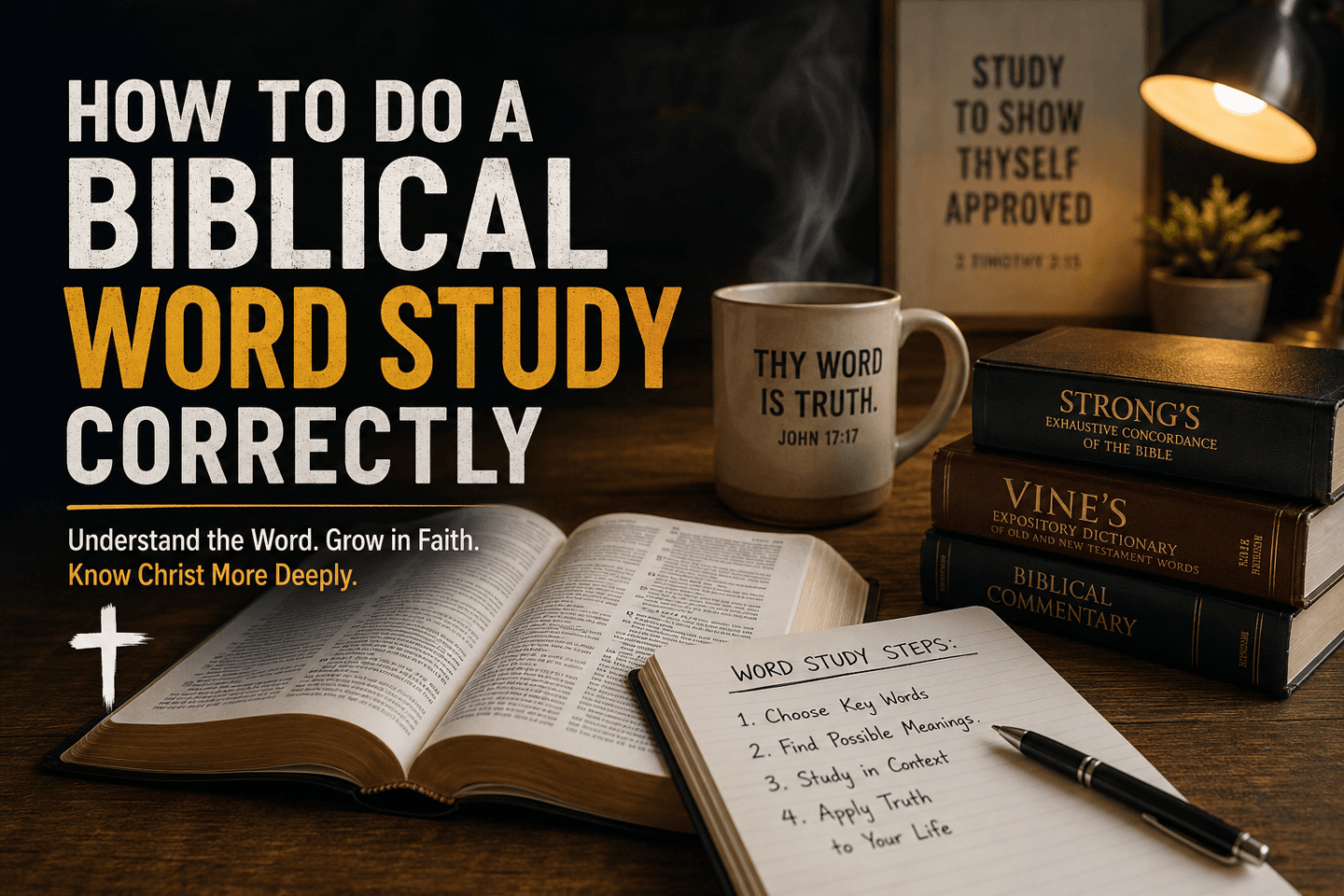
How to Do a Biblical Word Study: 7 Steps to Remember
Here is the complete process:
1. Choose an important word.
Study words that actually affect the passage.
2. Read the context first.
Paragraph before dictionary.
3. Compare Bible translations.
Notice meaningful differences.
4. Identify the Hebrew or Greek word.
Use Strong’s or Bible software carefully.
5. Study its range of usage.
Start with the same author and nearby passages.
6. Determine the meaning in this context.
Do not import every possible definition.
7. Check your conclusion and apply the passage.
Consult trustworthy commentaries and then move toward obedience.
That process is simple enough for an ordinary Christian.
Yet it is also disciplined enough to prevent many common mistakes.
How to Do a Biblical Word Study This Week
Choose one passage.
Do not choose ten.
Read the paragraph several times.
Then select one significant word.
Write down:
the English word,
its underlying Hebrew or Greek term,
how several translations render it,
possible meanings listed in a reliable lexicon,
several important occurrences elsewhere,
and the meaning that best fits your passage.
Next, write one sentence:
“In this passage, this word means…”
Then support your conclusion from context.
Finally ask:
“How should this truth shape my faith, worship, or obedience?”
That is a biblical word study.
No hidden code.
No linguistic magic.
Just careful attention to the words God inspired within the context He gave them.
Final Thoughts on Biblical Word Study
You do not need a PhD to study Scripture carefully.
At the same time, humility requires recognizing the limits of our knowledge.
Use tools.
Learn from scholars.
Study Greek and Hebrew if you have the opportunity.
Yet never confuse access to a Strong’s number with mastery of the language.
Most importantly, keep returning to the text.
A good biblical word study should make the passage clearer—not more mysterious.
Therefore, slow down.
Observe.
Study.
Compare.
Check the context.
Test your conclusions.
Then obey what Scripture actually says.
The goal is not to walk away thinking:
“Look what secret Greek meaning I discovered.”
Instead, faithful Bible study should increasingly produce something like:
“Now I understand God’s Word more accurately, and I want to live according to it.”
Continue Learning How to Study the Bible
For the most common word-study mistakes:
For why God’s Word matters:
For the broader Bible-study category:

I am a blogger, writer, pastor, Director of Zion Romania Bible School, husband to Olguta, a father and, most importantly, a child of God. I also completed my studies at the King’s University where I earned a B.A. in Theology with a concentration in Messianic Jewish Studies. I love Israel and I love the ‘Jewishness’ of the Bible.

[…] How to Do a Biblical Word Study Correctly: A Simple Guide for Every Christian […]