
This post may contain affiliate links. If you decide to make a purchase through these links, I earn a small commission at no cost to you. I do not promote anything I do not believe in or stand behind.
Exegesis vs eisegesis may sound like an academic debate—until someone challenges a decision you have made.
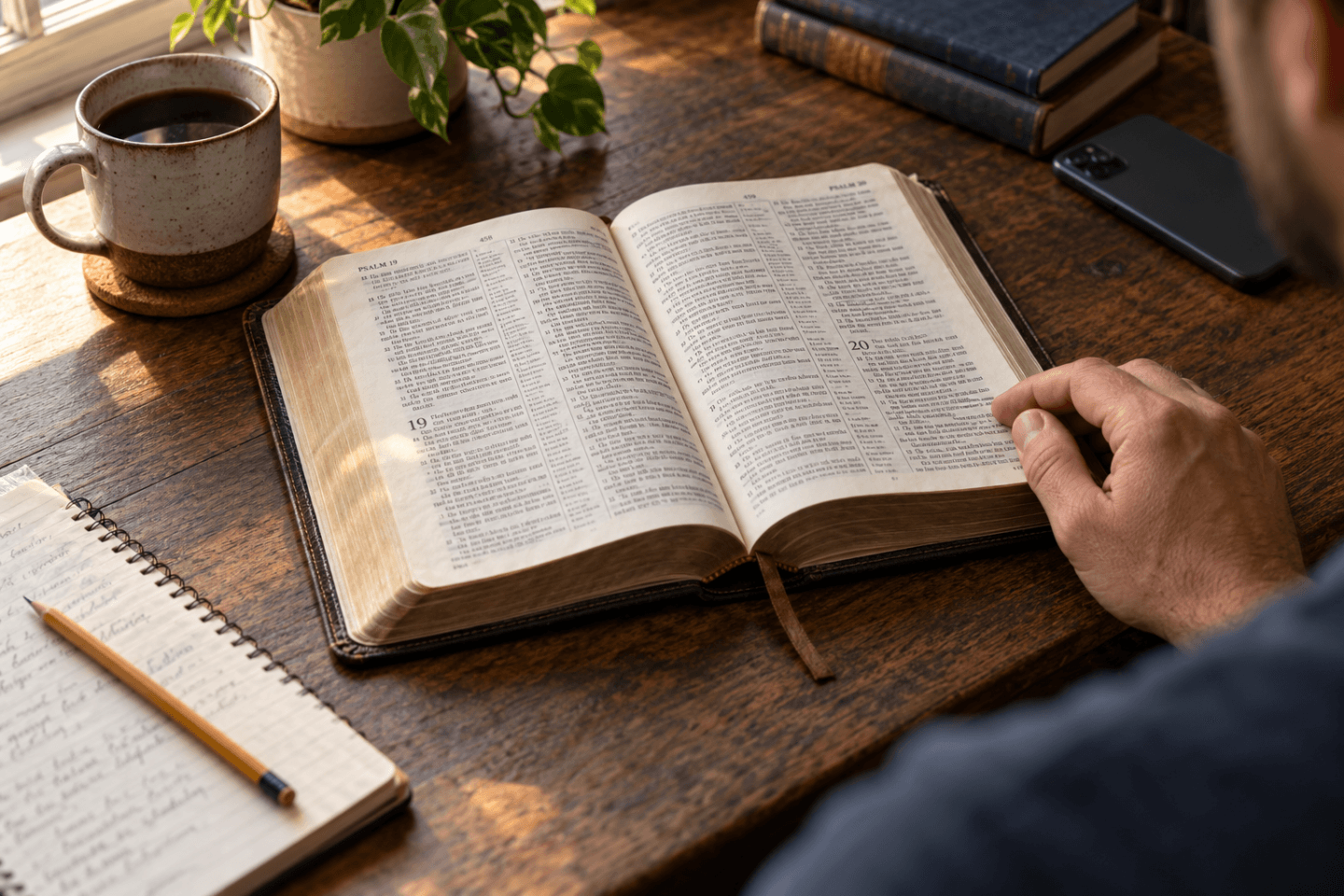
Your Bible is open beside your phone, and you already know which verse you want to send.
However, before pressing send, you read the sentences around it.
Suddenly, the passage sounds different. The verse you wanted to use against someone else begins asking questions about your own heart.
That uncomfortable moment brings us to exegesis vs eisegesis: the difference between discovering what Scripture communicates and making it support what we already want to say.
I can quote every word correctly and still misuse a passage. Therefore, faithful Bible reading requires more than remembering verses. It requires a willingness to listen, especially when God’s Word challenges me.
For a Christian man seeking to lead his family, resist temptation, or make wise decisions, this matters deeply. Our understanding of Scripture shapes our choices—and the people affected by them.
Exegesis vs Eisegesis: What Is the Difference?
Exegesis means carefully explaining a passage by examining its words, setting, and place in the author’s argument.
Eisegesis means bringing our own ideas into a passage without adequate support from the text. Nelson University describes the distinction in terms of whether we let the original context guide our understanding.
Consider these different starting points:
| Exegesis asks | Eisegesis assumes |
|---|---|
| What is the author communicating? | This verse must support my position. |
| How does the paragraph explain this sentence? | This sentence says enough by itself. |
| Which interpretation best accounts for the details? | The inconvenient details can be ignored. |
| What should change in my thinking? | My thinking does not need to change. |
Of course, everyone brings assumptions to the Bible. Our church background, experiences, and fears influence what we notice.
Therefore, the goal is not to pretend that we have no assumptions. We need to let Scripture test them.
A useful question is: What evidence in this passage would make me reconsider my conclusion?
If my answer is “nothing,” I may have stopped listening.
Why This Matters When You Struggle with Sin
Suppose a Christian man loses his temper at home. When his wife raises the issue, he responds with a verse about forgiveness.
Forgiveness matters. However, he may be using a biblical truth to avoid taking responsibility.
Similarly, another man reads a warning about sin and immediately concludes that God must have abandoned him. Because shame already controls his thinking, he overlooks the surrounding call to repentance and hope.
Both men need careful reading.
One needs Scripture to expose his excuses. The other needs Scripture to challenge his despair.
Consequently, responsible interpretation serves both holiness and assurance. It helps us receive the correction, comfort, and direction that a passage actually gives.
Before asking how a verse applies to someone else, I need to understand what it says—and how I must respond.
Exegesis vs Eisegesis in John 3: Water and the Spirit
John 3:5 provides a valuable example. Jesus tells Nicodemus that entering God’s kingdom requires birth “of water and the Spirit.”
What does “water” mean?
Before answering, follow the conversation:
- In verse 3, Jesus introduces the need for new birth.
- In verse 4, Nicodemus thinks about physical birth.
- In verses 5–8, Jesus explains the necessity of birth through the Spirit.
- In verse 10, Jesus challenges Nicodemus’s lack of understanding as Israel’s teacher.
The Greek word anōthen can mean “again” or “from above.” Nicodemus focuses on another physical beginning, while Jesus points toward life that comes from God. Bob McCabe discusses this distinction in his study of John 3:5.
Therefore, we should resist choosing a meaning for “water” before considering the whole discussion.
Our first task is to notice what Jesus emphasizes: religious knowledge and natural birth cannot produce the spiritual life Nicodemus needs.
Keep Reading: Baptism Appears Later in John 3
Sometimes the next helpful step is simply to keep reading.
In John 3:22–26, the narrative moves to baptism:
- Jesus and His disciples enter a setting of baptismal ministry.
- John baptizes where water is plentiful.
- A disagreement arises about purification.
- John’s disciples mention the baptismal activity associated with Jesus.
John 4:1–2 then clarifies that Jesus’ disciples performed the baptisms.
Therefore, water baptism and purification belong to the nearby literary context. We should take them seriously when considering John 3:5.
The study “The Interpretation of John 3:5,” published in Foundations, develops a baptismal reading partly through these connections and John 1:33.
However, we must distinguish an observation from a conclusion.
Observation: Baptism appears later in the chapter.
Interpretive conclusion: The water in verse 5 refers to baptism.
The observation gives us a reason to examine that conclusion. It does not establish it by itself.
After all, careful interpretation asks how a proposed meaning fits the whole passage, not merely one nearby word.
Look Back: The Promise in Ezekiel 36
Because Jesus expects an Israelite teacher to understand, the Old Testament also deserves attention.
In Ezekiel 36:25–27, God promises cleansing, a new heart, and His Spirit. The original setting concerns Israel’s restoration, and God’s action produces renewed obedience.
Notice the connection: water, cleansing, inner renewal, and the Spirit appear together.
Consequently, many interpreters understand John 3:5 against this prophetic background. McCabe argues that the expression describes the Spirit’s cleansing and transforming work. He also notes that John 3:6 and 3:8 describe birth through the Spirit without repeating the reference to water.
This reading deserves serious consideration.
At the same time, recognizing the Ezekiel connection does not make the later baptismal scene irrelevant. Some interpreters connect baptism itself with the cleansing promised by the prophet.
Therefore, good interpretation brings these details into conversation. It considers the immediate dialogue, the prophetic background, and the surrounding narrative.
Comparing Interpretations Without Forcing the Text
Three common interpretations help us see the work involved:
| Interpretation | Main support | Question to examine |
|---|---|---|
| Water means physical birth | Nicodemus discusses birth; Jesus contrasts flesh and Spirit | Was “born of water” an established expression for physical birth? |
| Water refers to baptism | Baptism and purification appear nearby | How does the outward act relate to faith and the Spirit’s work? |
| Water pictures spiritual cleansing | Ezekiel 36 connects cleansing water and the Spirit | How does this reading account for the baptismal setting? |
The physical-birth interpretation faces difficulties. In particular, a modern association with amniotic fluid does not establish how ancient hearers understood the expression. Meanwhile, baptismal and cleansing interpretations both appeal to substantial contextual evidence.
From my evangelical perspective, I understand baptism as the commanded outward expression of faith, while the Spirit gives new life. Nevertheless, that conviction does not excuse me from examining every relevant detail.
Likewise, identifying baptism in this verse does not, by itself, prove that performing a ritual automatically regenerates someone.
Disagreement is not proof of eisegesis. We must examine the reasoning, acknowledge difficulties, and remain teachable.
Exegesis vs Eisegesis in Philippians 4:13
Philippians 4:13 often appears beside ambitious goals. Someone may use it to claim certainty about winning a competition, building a business, or securing a promotion.
However, read verses 10–13.
Paul discusses contentment, hunger, abundance, and need. His confidence in Christ concerns living faithfully through changing circumstances.
An imposed reading says, “Christ guarantees the outcome I want.”
A contextual reading recognizes, “Christ strengthens me to remain faithful in the circumstances I face.”
Consequently, the verse still speaks when the business struggles or the promotion goes elsewhere.
Imagine coming home after a disappointing meeting. You can pray, resist bitterness, and care for your family because your strength rests in Christ.
The passage offers durable hope. Its promise remains meaningful even when your plans fail.
Matthew 7:1: Can Anyone Correct Me?
“Do not judge” can become a quick response when someone confronts our behavior.
Yet Jesus continues by describing a person with a plank in his own eye who notices a speck in his brother’s eye. He requires self-examination before helping the other person.
Therefore, the passage challenges hypocritical judgment. It does not give me permission to reject every correction.
Suppose a trusted friend asks about your drinking, anger, or secret online habits. Before quoting Matthew 7:1, consider the rest of the paragraph.
Is your friend acting with pride? That matters.
However, is his concern true? That matters too.
Likewise, if you need to confront another man, examine your own heart first. Your purpose should be his good, and your manner should reflect your own need for grace.
Reading the whole passage changes both how we give correction and how we receive it.
Exegesis vs Eisegesis: Six Steps for Faithful Bible Study
You can begin reading more carefully without knowing Greek or Hebrew.
1. Pray for a teachable heart.
Ask the Holy Spirit to help you understand and obey. Because pride distorts our reading, willingness matters alongside knowledge.
2. Read the whole paragraph.
Then read what comes before and after it. Notice the problem, question, or situation the author addresses.
3. Separate observation from interpretation.
Write two headings: “What the text says” and “What I think it means.” This helps you notice where an inference needs support.
4. Follow relevant biblical connections.
For example, Ezekiel 36 helps explain the themes in John 3. However, a shared word alone does not prove that two passages have identical meanings.
5. Compare careful explanations.
Consult a reliable commentary or discuss the passage with a mature believer. Also consider a thoughtful interpretation that challenges your own.
6. Choose one faithful response.
After understanding the passage, ask what obedience looks like today. Perhaps you need to apologize, reject an excuse, trust a promise, or change a habit.
Grace Makes It Possible to Admit We Were Wrong
Being corrected can feel threatening, especially when other people respect your Bible knowledge.
However, your standing before God does not rest on winning every theological discussion. Jesus died for sinners and rose again. Everyone who trusts Him receives forgiveness and acceptance through grace.
Therefore, you can admit that you misunderstood a verse.
You can apologize for using Scripture to silence your wife. You can reconsider an explanation you have repeated for years.
Because Christ has accepted you, correction need not destroy you.
The Holy Spirit continues to form believers through Scripture, prayer, repentance, obedience, and Christian fellowship. Although we still struggle with sin, we can keep growing.
Careful interpretation serves that growth. It helps us hear God’s correction without hiding and receive His comfort without inventing promises.
Before You Press Send, Read Again
Return to that open Bible beside your phone.
The practical question behind exegesis vs eisegesis is whether you will allow Scripture to examine the message you were about to send.
Today, choose one verse you frequently quote. Read its whole paragraph. Then write:
- What is the author communicating?
- What assumption have I brought to this passage?
- What response does this truth require from me?
Finally, take that step of obedience.
You may discover that your understanding was sound. Or you may need to change your words, your attitude, or your plans.
Either way, Christ gives you reason to approach Scripture with hope.
Before asking the Bible to support your answer, give it time to correct your question.

I am a blogger, writer, pastor, Director of Zion Romania Bible School, husband to Olguta, a father and, most importantly, a child of God. I also completed my studies at the King’s University where I earned a B.A. in Theology with a concentration in Messianic Jewish Studies. I love Israel and I love the ‘Jewishness’ of the Bible.

Leave a Reply